Technology Innovation
Initiatives to Develop Pioneering Technology
In the four areas of safety and security, service and marketing, operation and maintenance, and energy and the environment set forth in our Mid-to-Long-Term Vision for Technological Innovation, we leverage tools such as IoT, big data, and AI to aim to create new value through pioneering technological innovation. In particular, we are focusing on resolving management and frontline issues that the JR East Group faces, such as the declining working age population, energy and environmental issues, and measures to deal with increasingly severe natural disasters.
The Mid- to Long-Term Vision for Technological Innovation
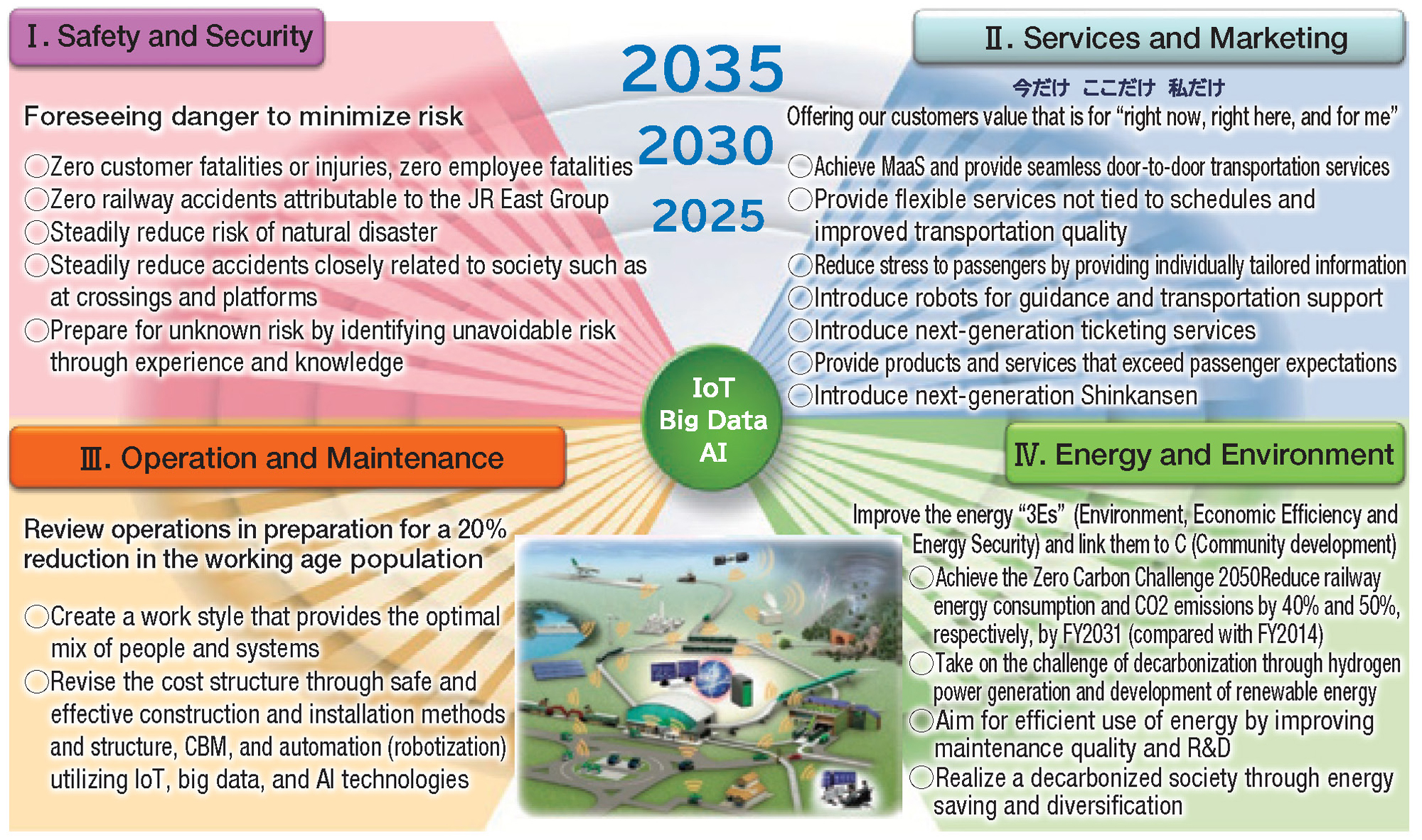
 You can pinch out to zoom in.
Major Initiatives
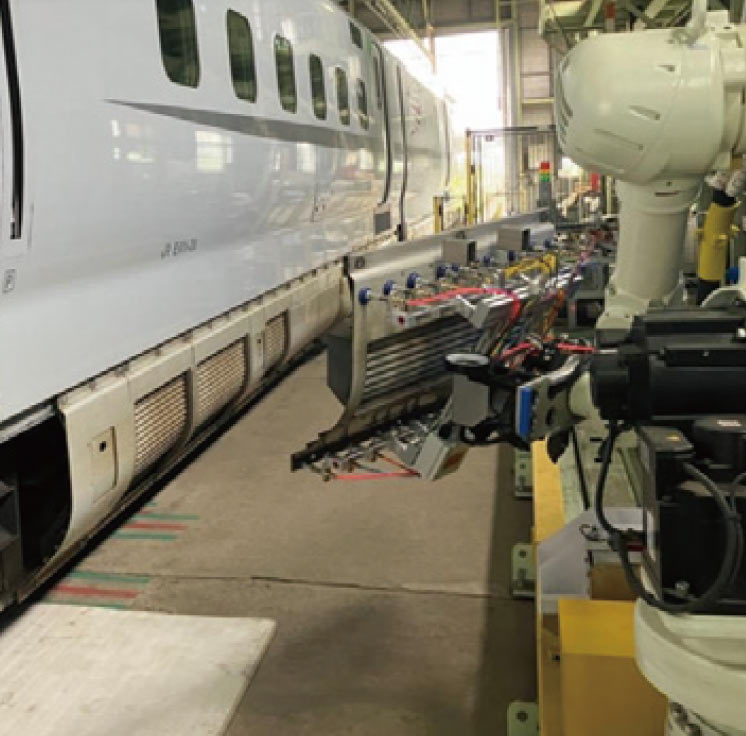
Shinkansen traincar side
skirt panel removal device
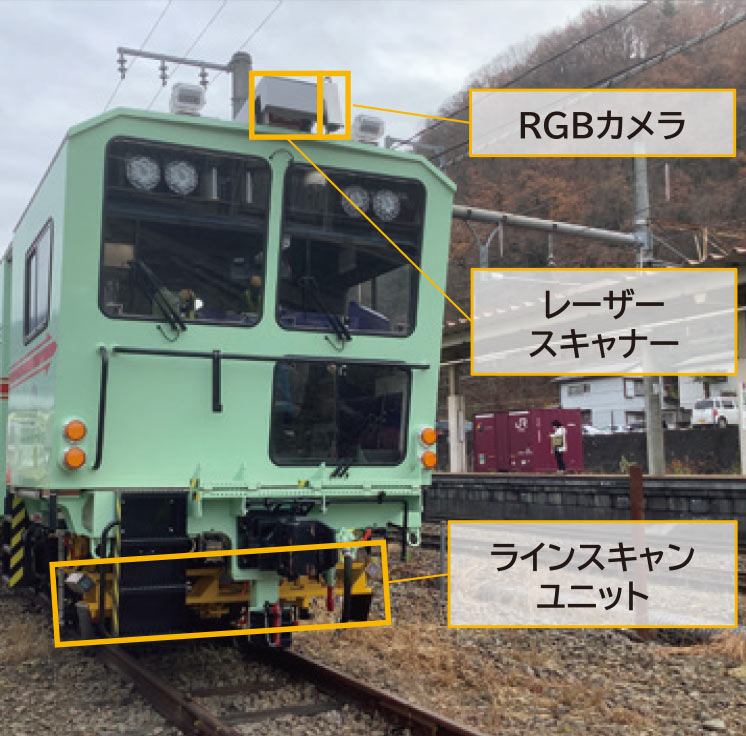
MTT auto tamping
support system
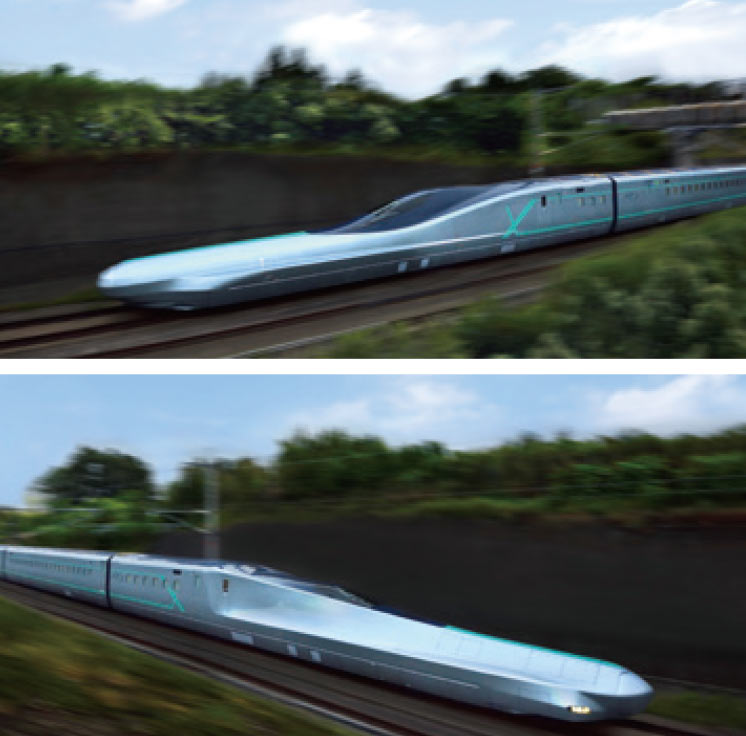
Next-generation Shinkansen
test train, ALFA-X
Utilizing AI to Support Recovery and Improve Inspection Efficiency
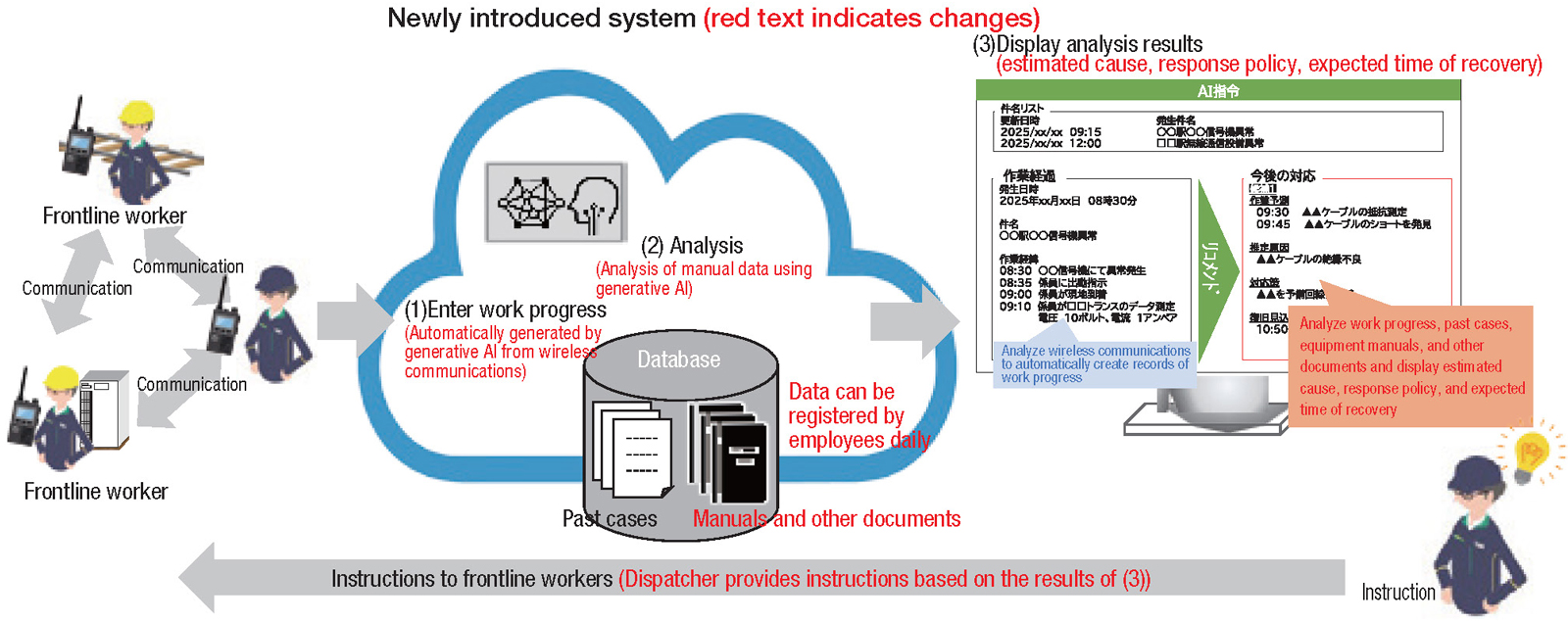
Recovery support utilizing generative AI in signal and communication equipment
In March 2023, we introduced an AI-based system to support decisionmaking
of dispatchers during disruptions for part of the signaling
equipment on conventional lines in the Tokyo metropolitan area.
During FY2026.3, we will enhance the current system by incorporating
generative AI to shorten recovery time during disruptions in signal and
communication equipment, deliver timely information to customers,
and move beyond reliance on individual employee knowledge and
experience. In addition to further enhancing the functionality of the
system to be introduced, we will consider expanding its use to other
areas.
You can pinch out to zoom in.
Introducing AI to Inspect Shinkansen Tunnels
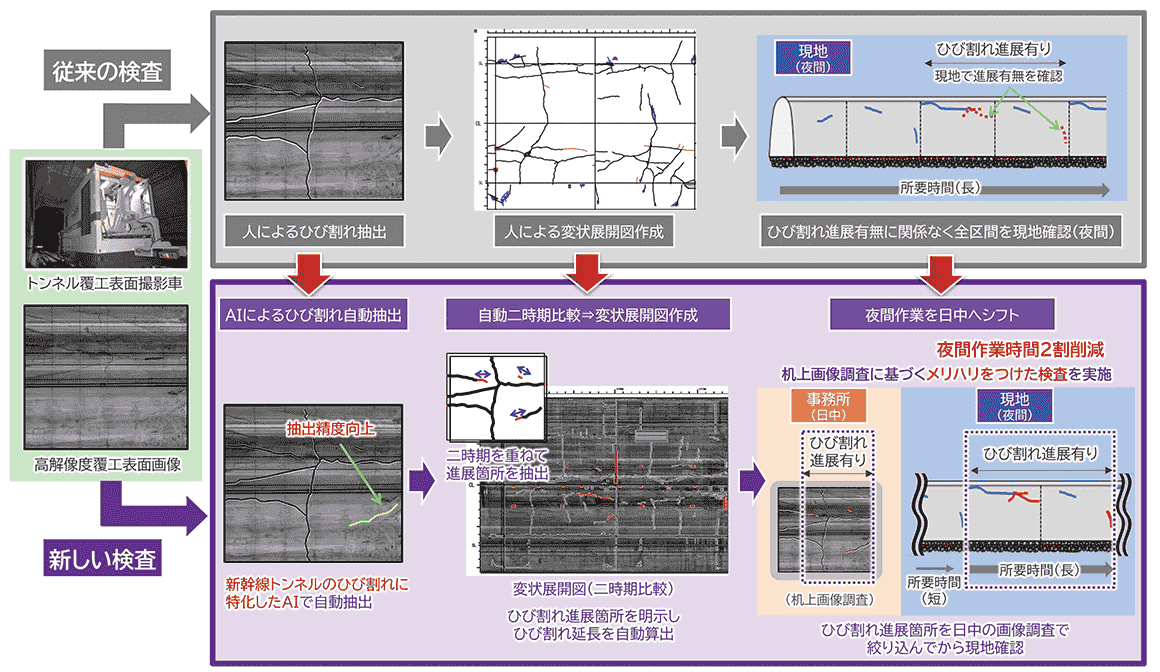
Railway civil engineering structures are inspected regularly to ensure safe and stable train transport, and railway tunnels are inspected, focusing on cracks in the surface of the lining concrete. We have developed technology that uses AI to automatically identify cracks from images in the surface of the lining concrete in Shinkansen tunnels, as well as technology that compares cracks from two different periods. This marks the first time these technologies have been combined to digitally inspect Shinkansen tunnels in Japan.
Enhancing Inspection Efficiency
By applying the two new aforementioned technologies to create a deformation diagram, we have reduced the risk of overlooking cracks, identified areas where cracks have progressed, and shortened nighttime work hours by 20%.
Future Outlook
In addition to introducing inspection that uses new technology in FY2026.3, we will create a framework that uses images to enable confirmation and inspection from the lining to the railway roadbed, thereby promoting more efficient inspection and a digital transformation.
Developing Diverse Talent with Digital Technology Skills to Promote DX
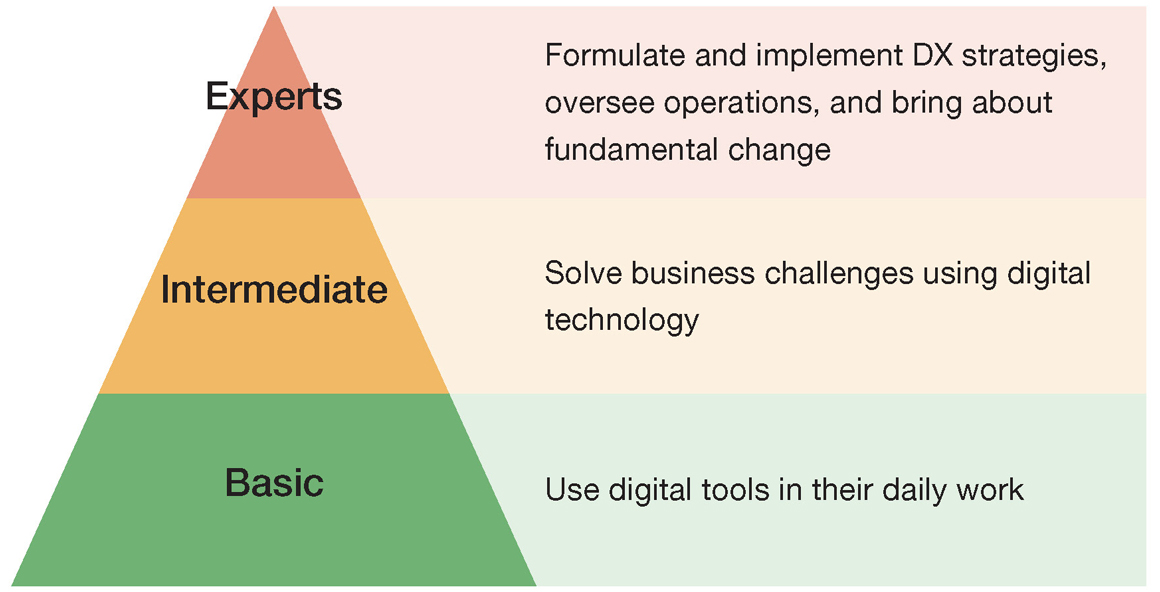
By the end of fiscal 2032, we aim to train and certify 11,000 employees to develop expert personnel capable of formulating and implementing DX strategies, as well as mid-level personnel who can solve business challenges at each location by creating advanced applications and share the IT skills and know-how which they have acquired with regular employees. In this way, we will foster a culture where each department proactively uses digital technology to solve issues.
Development of Human Resources with Digital Technology Skills by DX Pros
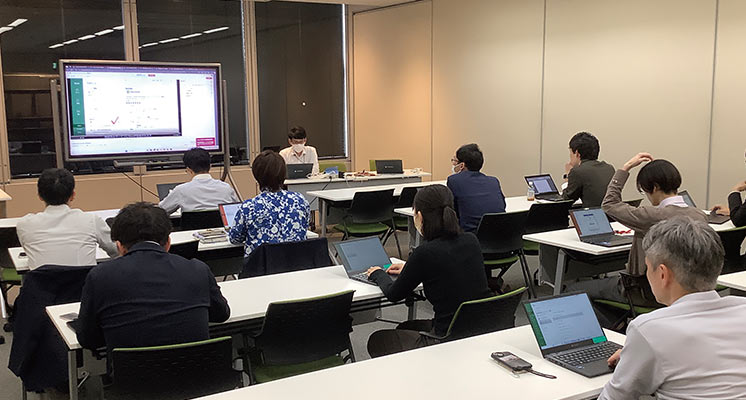
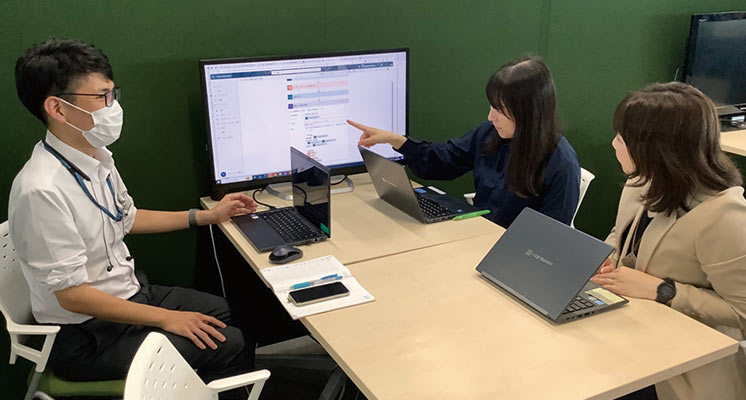
In November 2023, approximately 40 DX Pros including myself were
appointed to various institutions as dedicated people in charge
of driving DX in JR East. DX Pros provide hands-on training in
no-code and low-code tools, mainly using Microsoft 365’s Power
Automate and PowerApps. We are fostering a culture of promoting
operational improvement and efficiency by encouraging employees
to create their own apps to address workplace challenges. They
also act as evangelists, sharing best practices such as apps created
in one workplace to other sites, thereby promoting efficient digital
improvements. Through these initiatives, the development of
companywide digital human resources is gaining momentum at an
accelerating pace, having already quickly achieved by the end of fiscal
2028 training targets of 5,000 Intermidiate employees and 25,000
Basic employees by the end of fiscal 2025.
Looking ahead, we plan to further enhance the digital skills mainly
of Intermidiate employees, with the aim of accelerating operational
efficiency through the use of digital technology without relying solely
on DX Pros at each workplace. DX Pros will work to raise the DX
literacy of all employees through digital human resources training,
thereby driving greater operational efficiency across the Company.