Message from the President

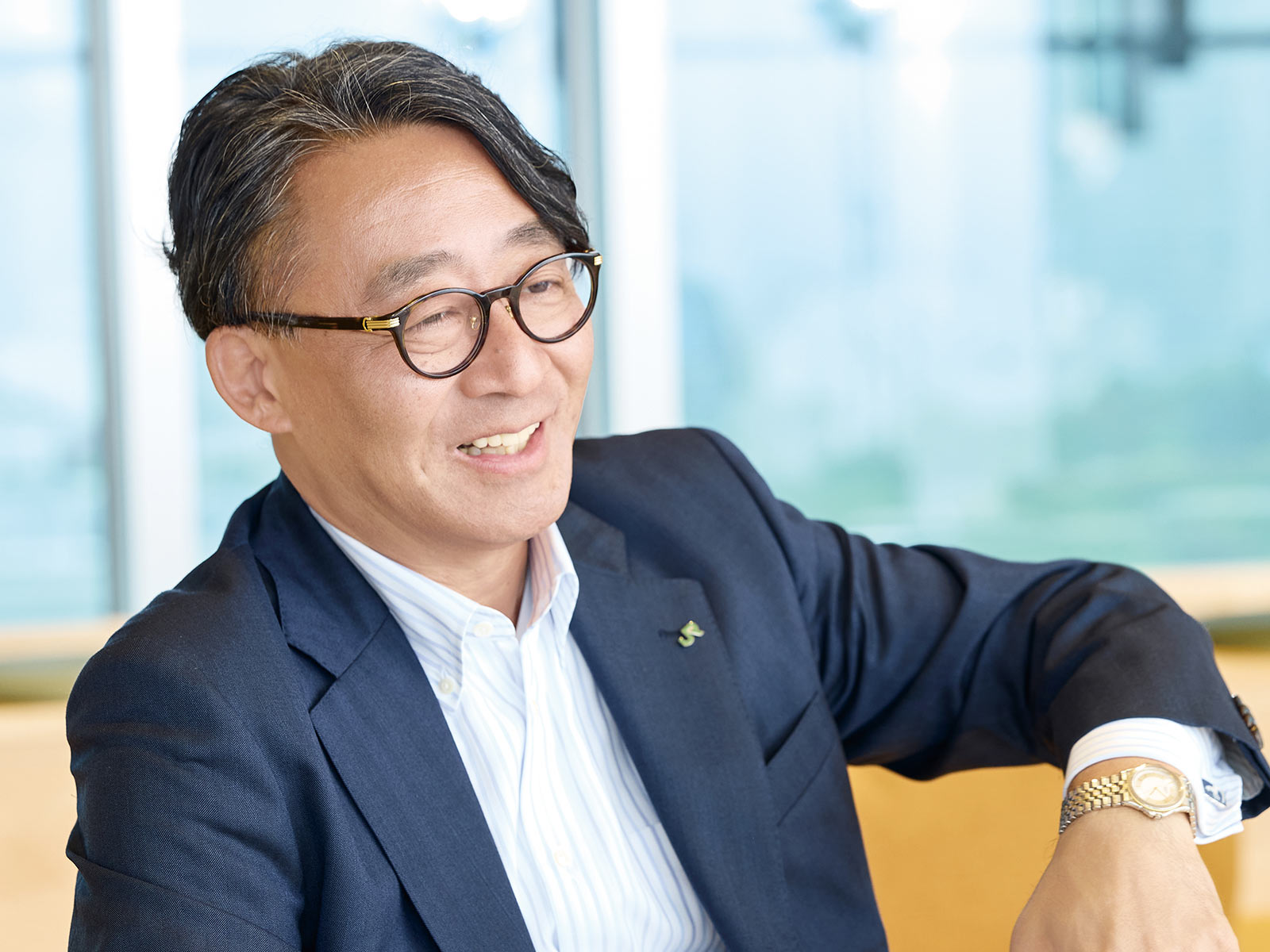
Linking the Past and the Present as We Open the Doors to the Future
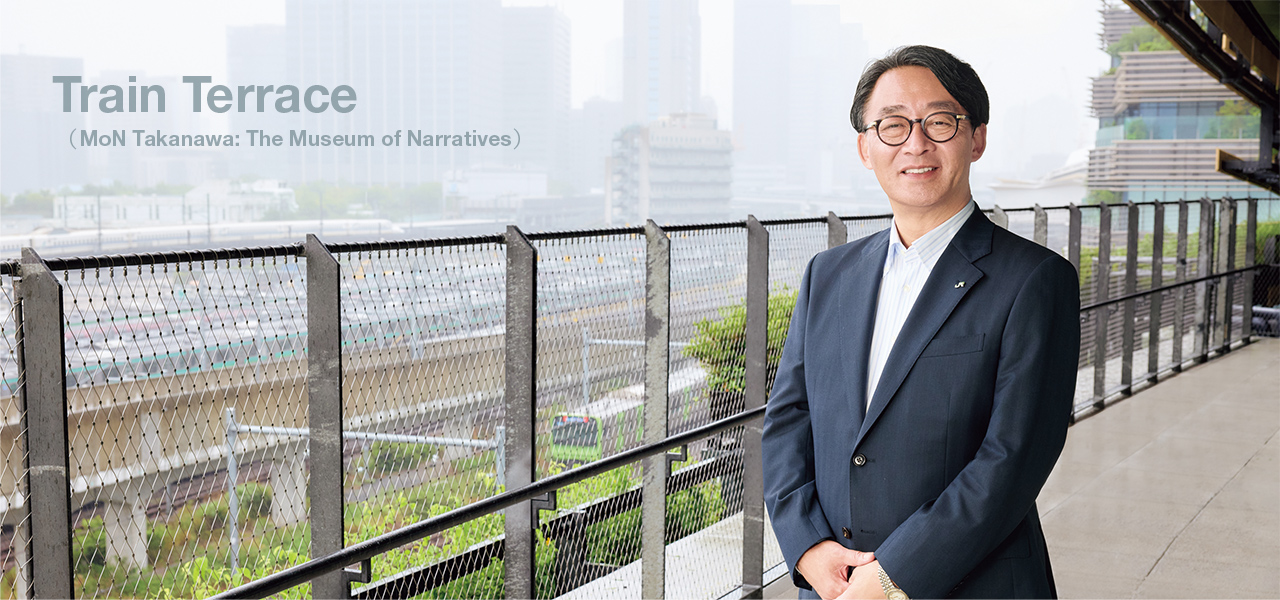
The first phase of TAKANAWA GATEWAY CITY, from where I share this message today, officially opened on March 28, 2026, twenty years after it was first conceived.
Takanawa, where TAKANAWA GATEWAY CITY is located, lies along the rail route between Shimbashi and Yokohama. This is Japan’s first rail route, and it was opened in Meiji 5 (1872). In that sense, for us as railway professionals, Takanawa is where it all began. Railways were a symbol of modernity during Japan’s Meiji era, so this could also be seen as where Japanese innovation began. Looking further back in history, Takanawa was also home of the Takanawa Great Wooden Gate, which was called the gateway to Edo and was the starting point of the Tokaido road. That’s where the name “GATEWAY” came from.
In developing Takanawa, the foundation of new growth for the JR East Group, we wanted to carry on its history and lineage. We looked a century into the area’s future, from a global perspective, and formulated the concept of making it an experimental site that would create new innovation. I think that this concept was achievable thanks to the JR East Group’s independent urban development capabilities.
Some of the key themes of this experimental site are taking on the challenges of the medical field in order to reach century-long healthy life expectancies, taking on energy challenges through the use of hydrogen and GX, and opening Japan to the world as a nation of knowledge, developing leaders of the next generation. These are all issues facing Japanese society that will be prerequisites for the growth of the JR East Group. In the medical field, new inspection technologies have already been developed for applying AI to CT images to detect colorectal cancer, and preparations for realworld deployment of these technologies are underway at a clinic within the area. In the energy field, an energy system is being built that will assist with the cooling and heating of the entire area, primarily through the use of one of the largest underground thermal storage tanks in Japan. Work is also being performed on verifying the use of hydrogen in mobility and in urban living. Takanawa is also a place for creating future models that solve social issues while creating new value.
In our development of TAKANAWA GATEWAY CITY, we discovered remains from the Meiji era, when Japan’s aforementioned first-ever railway was built. At the time, a causeway was built over the sea and trains ran along it. We discovered this embankment, still in good condition. This was an unexpected discovery, and it felt to us as though a timeline that connected the past, the present, and a century into the future, had emerged with remarkable clarity through this major urban development project.
As president of the Company, I believe it is my mission to develop a major turning point in the history of the JR East Group, to open the door to a new era, and to shape the future of the JR East Group. When I think about the symbolic vista that is the opening of TAKANAWA GATEWAY CITY, and I mentally overlay it on my own mission, it makes my resolve all the deeper.
Fueki Ryuko: “Ultimate Safety” and “Transformation”
It’s been a bit over two years since I was appointed President and CEO in April 2024. As the head of our Group’s management, I always keep in mind that, in my position, I must tackle various issues every day, always making the best decisions and dealing with matters in the best way. Within that, I place special importance on the concept of “fueki ryuko,” or “adopting change within the unchanging.” This concept of Japanese linked verse, championed by the poet Matsuo Basho, is also used in the world of the tea ceremony. “Fueki” refers to the essential nature that must remain unaltered, while “ryuko” means transforming with the times.
Our founding business is railway operation, and in our business activities, we engage with customers in various ways. Needless to say, for the JR East Group, one example of “fueki” is ensuring safety. This must always remain one of the top priorities of our management. We take the humble stance that there is no such thing as absolute safety and that efforts to improve safety never come to an end. Through the diligent day-to-day initiatives of Group employees, we must ceaselessly raise our level of safety. We call this philosophy of safety “ultimate safety,” and we dedicate ourselves to achieving it through safety education and through the introduction and use of devices and systems for preventing human error. However, looking back over the past two years, we’ve experienced issue after issue, such as the decoupling of Shinkansen during operation and major transportation service disruptions resulting from a power outage on Tokyo metropolitan area train lines. I feel profound regret for these incidents, which are also painful examples of my own inadequacies. We will continue to make unflagging efforts to achieve “ultimate safety,” with renewed resolve.
Transformations that are seen as “ryuko,” changing with the times, include the fundamental reforms of JR East’s personnel and wage systems, discussed in detail later, as well as an overhaul of the business operating framework through reorganization. In light of changing employees’ views on work, we’ve implemented the reforms with an eye to making a change in traditional systems inherited
from Japanese National Railways (JNR). Moreover, at the same time as TAKANAWA GATEWAY CITY’s grand opening, we opened OIMACHI TRACKS, which was developed at the site of former company housing in Oimachi, and co-creation urban development across the expansive Greater Shinagawa Area began in earnest. By creating new value for the capital city, Tokyo, through urban living innovation, we are building a growth platform that will enable us to generate over ¥100.0 billion in annual revenue by the mid-2030s.
Another transformation I would like to present as an example of our “ryuko” initiatives is the announcement of Suica Renaissance, a newly evolved version of Suica, a widely used transportation IC card and form of e-money. I see this as an epoch-making transformation in our operations. When Suica was released in 2001, it was an innovative device that transformed ticketing. However, 25 years have passed, and numerous competitors have appeared. Suica is no longer necessarily the top runner. We are evolving Suica from a mobility and small payment tool to a device for lifestyle that is connected to customers’ and local communities’ broad range of lifestyles. I am confident that this will enable Suica to regain its former status. What’s important here will be speed and coordination, both inside and outside the Group.

Upward Revisions to the Numerical Targets of “To the Next Stage” 2034
Both consolidated revenue and profit increased in every one of our business segments in FY2026.3, and we achieved the stand-out result of surpassing ¥3 trillion in operating revenue. In particular, passenger revenue has risen back up to 99.6% of its historical peak in FY2019.3, before the COVID-19 pandemic. We anticipate passenger revenue in FY2027.3 to be 105.2% of what it was in the previous year, so even without the fare revision, this would exceed FY2019.3 levels. Railways are ready to transition from the post-COVID-19 stage to the next stage. This is the product of the efforts by each and every employee, day in, day out, and it fills me with great pride.
In our Lifestyle Solutions, we had two milestones in FY2026.3—the grand opening of TAKANAWA GATEWAY CITY and OIMACHI TRACKS. We also achieved major milestones in our real estate business, which we have positioned as a future growth engine. In April 2026, we announced that real estate subsidiaries of the ITOCHU Group and our Group would be integrating and forming a new company in October. The two Groups would fuse their strengths to expand and accelerate their real estate business. We expect to achieve this expansion through our real estate rotation business model, and we have established a base for our future expansion, such as upwardly revising our FY2032.3 target for the asset management scale of our real estate fund business from ¥1 trillion to ¥1.2 trillion.
Based on the significant progress I feel we are achieving toward this new growth, we revised the numerical targets of “To the Next Stage” 2034, raising our operating revenue target for FY2032.3 from “over ¥4 trillion” to “approximately ¥4.3 trillion”.
In our Mobility business, we raised fares for the first time, effectively, since our Company was founded, and we achieved a step change for rail demand. In our Lifestyle Solutions, we incorporated larger numerical targets under Beyond the Border and accelerated the timetable for
achieving them. We are increasingly confident that our dual-axis management strategy can not only outperform our initial expectations, but also deliver sustainable growth in this inflationary environment. It’s extremely rare to revise medium- to long-term plan numerical targets within less than a year after they’re announced. This revision demonstrates to stakeholders the confidence and resolve that the JR East Group has towards its growth potential.
The Goals of Our People-Focused, Market-In Approach
We are promoting JR East Transit-Oriented Development (J-TOD), a unique JR East Group approach that leverages the synergy of our Mobility and Lifestyle Solutions. Needless to say, the TAKANAWA GATEWAY CITY and OIMACHI TRACKS projects are part of J-TOD.
In Takanawa, five years before we opened TAKANAWA GATEWAY CITY, we opened Takanawa Gateway Station as a new station on the Yamanote Line in 2020. The improved rail convenience increased the value of Takanawa and has helped office buildings in the area achieve higher unit prices and attract more customers than those in surrounding areas. That said, before the opening of TAKANAWA GATEWAY CITY, Takanawa Gateway Station only served approximately 20,000 people a day. Following the opening, if tenancy in office buildings increases in the future, we anticipate the station growing into one that serves about 240,000 to 250,000 people a day. Based on our experience so far, we have raised our annual operating revenue forecast for steady operation from ¥57.0 billion to ¥65.0 billion for TAKANAWA GATEWAY CITY and from ¥13.0 billion to ¥15.0 billion for OIMACHI TRACKS. Only the JR East Group can leverage its dual-axis management of railway-centered Mobility and Lifestyle Solutions to pursue a development model that generates this kind of high profitability from its own assets.
At the base of these J-TOD initiatives are our people-focused, market-in approach. The “people-focused” concept was first set forth in “Move Up” 2027, the Group Management Vision we formulated in 2018. As I was involved in the plan’s formulation as the director general of the Corporate Planning Headquarters, this expression resonated deeply with me.
For 30 years since our Company’s founding, we have done business rooted in railway infrastructure. This was in line with the objectives of the JNR reforms, namely revival and restoration of railway, and it was by no means a mistaken direction to take. However, when we developed
“Move Up” 2027, we believed that, looking ahead, we believed that our starting point shouldn’t be railway infrastructure, but instead all people, encompassing our customers, local communities, shareholders and investors, Group employees, and their family members.
In “To the Next Stage” 2034, we further refined the concept by adding “market-in” to “people-focused.”We will address the latent needs of society and our customers, leveraging the strengths we have developed to create new business as only the JR East Group can.
The Future Made Possible by the Suica Renaissance
In doing business using a people-focused, market-in approach, a key platform in the future will be the evolving Suica platform. Both our Mobility and Lifestyle Solutions have real-world contact points with our customers. The core of the management vision I have for our Group is to continue to steadily grow these two axes while also fusing the two to create value as only our Group can. I have positioned Suica as the foundation from which we will realize this vision. On top of this digital foundation provided by Suica, we will build business growth along our two real-world business axes. We will aim to expand the Suica living sphere using this approach.
The Suica living sphere goes beyond transportation. It is one in which Suica seamlessly links all kinds of aspects of life, including shopping, home living, medical care, finance, and government procedures. Payment within the living sphere covered by Suica is also positioned as a service. I don’t use the phrase “ecosystem,” instead intentionally using the phrase “living sphere.” Customers will use diverse services provided by the Group through Suica, even if customers are not consciously aware of it. Our ideal is for this to permeate people’s daily lives, which is why I call this vision a “living sphere.”
The evolution of Suica, driven by the Suica Renaissance announced in December 2024, is now moving into full swing. We are bringing about a new evolution of Suica by making it more convenient and expanding its functions. We plan to increase the number of Mobile Suica issued from 42.14 million in FY2026.3 to 70.0 million in FY2032.3, expanding the Suica living sphere. From autumn 2026, the new teppay QR code payment feature will enable purchases of up to ¥300,000, exceeding the previous ¥20,000 e-money limit. If linked to our Group’s house brand credit card, ViewCard, Suica can be used effectively up to the credit card’s credit limit, eliminating the need to charge the Suica in advance. Some customers find tapping the Suica to be inconvenient, so from the spring of 2027 we will introduce walk-through ticket gates that use ultra-wideband (UWB) technology, eliminating the need for tapping the Suica to the ticket gate. We plan to begin the trial introduction in roughly 10 stations, including five stations in the Greater Shinagawa Area (Takanawa Gateway, Shinagawa, Oimachi, Tamachi, and Hamamatsucho).
In the spring of 2027, we will also start rolling out Community Suica, which addresses various community needs, such as needs for government services and MaaS. We will start with Community Suica in Gunma Prefecture and Miyagi Prefecture. We will also turn Community Suica into a platform that serves as a base for dual-location living. In TAKANAWA GATEWAY CITY residences, we will also pilot test smart home services integrated with Suica, such as having a user’s appliances automatically start operating when the user passes through the ticket gate on the way home, or matching delivery timing with delivery personnel. Another of our pilot testing themes will be supplying wellness and healthcare services based on user sleep and health data. The future in which Suica moves away from the ticket gate and becomes a tightly linked part of users’ daily lives is just around the corner.
We expect Suica Renaissance to increase operating income by ¥25.0 billion plus additional upside. It is precisely this additional upside that we believe has the greatest potential to expand going forward. From the spring of 2027, the JR East Group will switch from magnetic tickets to QR code tickets. At the same time, we will implement ticketing reforms using Suica, reorganizing ticket vending machines and ticket gates. We will be able to use the space freed up for new businesses and services, creating opportunities to achieve an unprecedented
level of earning power. We expect the reductions in the number of ticket vending machines and ticket gates to also lower maintenance costs, so our business will grow both through revenue increases and cost reductions. The Suica Renaissance will make significant contributions to taking both our Mobility business and our Lifestyle Solutions to the next stage.

A True Technical Services Corporate Group
One of the key concepts that supports growth, as set forth in “To the Next Stage” 2034, is being a true technical services corporate group. Our railway-centered Mobility business and our Lifestyle Solutions are both, essentially, service businesses in which we have connections with our customers. However, they aren’t simply service businesses. We want to be a services corporate group that uses the power of technology to innovate and that grows by creating new value. That’s the spirit behind our vision.
Through our history, we have used technology to create new value. For example, we have used it to improve safety, or to introduce Suica, Japan’s first transportation IC card. Going forward, we will further adopt state-of-the-art technologies such as AI and digital technologies while improving the competitiveness of our existing businesses and creating new business opportunities.
Innovation through technical capabilities will be one of the main driving forces that support our Group’s growth. I have positioned FY2027.3 as “Year 1 of DX and AI,” and I have announced a policy of accelerating our use of AI and digital technologies in our services and operations. In the Mobility business, we started to use AI image analysis and drones to perform facility inspections in the event of a transportation disruption. For railway maintenance, we are expanding and enriching the functions of our analysis platform, while promoting the use of autonomous robots that travel within the railway tracks to improve our maintenance operations. As for counter operations, I would also like for AI to handle most customer inquiries and ticket issuance at JR Ticket Offices in the next few years. We began pilot testing of this at Tachikawa Station and Omiya Station in July 2026.
In the future, I don’t believe AI-free management will even be feasible. At the same time, developing personnel who can fully leverage AI’s potential, and improving AI literacy, are urgent tasks that we must address. With respect to the use of AI, some take a negative view,
believing that AI will take jobs, but I don’t think so. I believe we should see it in a positive light: we can entrust AI with the work it is capable of and use the time and resources that are freed up to create value that only humans can create. This, in turn, will enable our employees to thrive on an even greater stage.
The task of management in the age of AI will be to create this new field for our employees and use it to drive the growth of our Group.
We are looking beyond AI and digital technologies, too, positioning outer space as a new field for value creation. We are taking on the challenges of creating services that dramatically transform the “norm.” These include next-generation stable transportation systems that use satellite communications and walk-through ticket gates in regional areas.
Our Resolve to Eliminate Transportation Service Disruptions and the Measures We Are Using to Achieve This
Over the past two years, we’ve experienced one major transportation service disruption after another. These have tremendously inconvenienced and worried our customers, and as the president of the Company, I would like to express my sincere apologies.
Each of these incidents had a separate cause, some of which were due to some kind of human error, including improper equipment handling. But I want to state, clearly and unequivocally, that this is not a problem in the work done by our individual employees, but a problem in our management, having employees do this work.
I don’t think that any of the employees of the JR East Group, be it employees in our Mobility business or employees in our Lifestyle Solutions, do half-hearted work. None of our employees are neglectful in their work, failing to recognize that we serve the public interest, or that we are responsible for protecting the precious lives and properties of our customers, and the precious lives of our colleagues. I am proud to be able to work with employees with such a strong dedication to their mission and such a strong sense of responsibility.
And yet we are having them perform work which has resulted in these transportation service disruptions. The fault for this ultimately lies in my approach to managing the Group as president. That is how I see it.
On February 10, 2026, I issued a formal apology for the transportation service disruptions that had occurred and announced “Future Initiatives” consisting of six initiatives. I came up with and formulated these six initiatives on my own, while consulting with those around me. The first measure is to perform a sweeping review of our work procedures. We are thoroughly reviewing procedures of work with the potential to cause major inconveniences to customers, and work which involves protecting customers’ lives. We’re strengthening our checking systems and introducing new systems to prevent major problems from occurring.
We will steadily carry out these initiatives to not only eliminate transportation service disruptions but also raise the overall safety level of the JR East Group, including the Lifestyle Solutions.
Restoring Trust in Our Governance and Compliance
The JR East Group is now being called upon to restore trust in two respects. One is trust in the safe and stable operation of our railways, as I mentioned earlier. The other is trust in our governance and compliance.
From 2024 to 2025, a series of incidents of misconduct by the Company and Group companies came to light. These included falsification of press-fit force values in wheelset assembly, fraudulent billing in projects commissioned by the national government and other public bodies, and conduct that may violate the Antimonopoly Act. These all caused severe damage to stakeholder trust, and they have called our stance on governance and compliance into question. We recognize the gravity of this situation.
In response to this, we don’t see this as a matter of different isolated issues, but as a question of our Group’s overall governance and compliance. For that reason, in July 2025, we established an Expert Committee and external experts, commissioned external experts to conduct a thorough review of our governance and compliance, and formulated improvement measures. In March 2026, we announced our governance and compliance improvement measures,
we updated the “JR East Group’s Basic Approach to Its Internal Control System,” and we made improvements to our promotion structure throughout the entire Group. I have personally called our Group employees’ attention to the importance of restoring the soundness of our organization and workplaces and creating a sound and trusted Group once again.
In June 2026, we formulated and announced the “JR East Group’s ‘Determination and Commitment’” as guiding principles for all Group employees P.2 . Our “Determination and Commitment” is an expression of the determination of each and every employee in the JR East Group, and their commitment to society, to uphold compliance and rebuild our Group as a sound, healthy corporate group. The JR East Group will begin moving forward once again as a sound corporate group and earn back the trust we have lost. That resolve is encapsulated in our “Determination and Commitment.”
It is our great duty and our management imperative to restore trust in our governance and compliance as soon as possible, and to further strengthen it.
Creating an Organization Which Provides Employees with Job Satisfaction and a Sense of Personal Growth
Roughly 100,000 people currently work for the JR East Group. Each and every one of them is motivated to grow, and they are demonstrating their exceptional capabilities and thriving in their respective workplaces. The Group’s management is tasked with expanding the fields of work and activities of these employees, who play leading roles in creating value, so that they can further improve their own capabilities while experiencing even greater job satisfaction and more of a sense of personal growth, contributing to the growth of the Group as a whole. In the organizational restructuring we carried out on July 1, 2026, we eliminated the two area headquarters and 10 branch offices which had managed train stations and other frontline workplaces based on geographic areas. Instead, we used a market-in approach, creating an organization structure with 36 regional headquarters and flattening our organization. We also delegated management authority for tourism development and the solving of regional issues to frontline workplaces. In the past, we had distinguished between on-site and off-site work, but we have now eliminated that distinction, and I think it would be fair to say that we have transitioned to a work system in which each and every employee can take the initiative, take on challenges, and create value. By creating a field for employees, where they can feel job satisfaction and a sense of personal growth more than ever, we will strengthen engagement between employees and the Company. I am confident that this, in turn, will become a powerful driver of the Group’s growth.
The two area headquarters and 10 branch offices that we eliminated in this organizational restructuring were intermediary white-collar workplaces, and the roles they played continue to be important. However, in the near future, these functions will likely be replaced by AI. Since we can already envision this, this organizational change, and the fusion of regional headquarters and branch offices with frontline workplaces, is a very significant one. This reorganization will enable us to work faster, and with greater precision, in every area, whether it be safety, Customer experience, or solutions to regional issues.
Another of our personnel-related measures was the revision of our personnel and wage systems on April 1, 2026, before the organizational restructuring. Our personnel and wage systems have undergone numerous small changes since our Company was founded. Our most recent large-scale revision was the model change I formulated as the deputy department director of the Personnel Department in 2012. I believe that with the current personnel and wage systems, we’ve eliminated most of the issues that remained following the last revision.
One of the key points of these changes is that, from the perspective that employee growth drives company growth, we have instituted a system that scrutinizes and evaluates employee growth even more closely when making pay raise decisions.
Before the revision, when so-called regular salary increases were given, 80% or more of employees at the same rank would get the same raise. There were very few differences between them. The new system more closely reflects the effort put in by each employee.
Also, from the perspective of making it clear, through wages, that the quality of our rail transportation is maintained and supported through the involvement of all employees, we pay uniform allowances to all employees, without discriminating between the work performed by those on the frontlines, such as station personnel, crew members, and maintenance personnel, and the work performed in the back office. I think this is another key point of these reforms. Our reorganization and the revisions to our personnel and wage systems are positioned as two pillars in the promotion of “To the Next Stage” 2034.

Envisioning the Future Together with Our Stakeholders
Since being appointed president, I have cherished the spirit of “management that is good for all.”
Our business activities are aimed at creating a better society. Through them, we strive to grow profits while solving social issues. We will return the profits garnered from these business activities to our customers, local communities, shareholders, investors, our Group employees, and their families. Moreover, we will also invest these profits in the future growth. This creation of a virtuous cycle embodies the spirit
of “management that is good for all”.
The social issues that surround us, be they declining birthrate and aging society, regional population decline, or energy problems, are growing more complex. However, I believe that sincerely taking on these issues and helping solve them through our business activities will contribute
to the sustainable growth of our Company.
But simply being sustainable isn’t enough for a company. Companies can’t just continue along their current trajectories; they must stay ahead of changes and achieve discontinuous growth. I’m taking on that challenge through “To the Next Stage” 2034.
In practicing “management that is good for all,” there are some things I want to share with all of our stakeholders.
For our customers and local communities, we will build the Suica living sphere to create communities that are even more convenient and give people a greater sense of fulfillment, thereby meeting expectations for our Group. We will consistently satisfy the expectations of those in
urban areas by meeting urban demands, the expectations of regional areas by meeting regional demands, and the expectations of those outside Japan by meeting the demands of their respective regions. I’m not just talking about a concept, I’m talking about plans that we are uniquely positioned to implement.
Because Japan’s population is declining, there are some who believe that there might be no potential for the railway business to grow. To our shareholders and investors, I want to emphasize that the JR East Group’s railway business is a growth business. Our Green Cars of the Chuo Line Rapid service, which addresses customers’ seating needs, generated top-line revenue above our expectations. This is an example of the room we have for further growth if we connect urban and regional needs with business on a granular level. Another example is raising the operating revenue target for FY2032.3 under the Medium- to Long-Term Growth Strategy for Mobility Business “PRIDE & INTEGRITY” from ¥200.0 billion to ¥300.0 billion.
In our Lifestyle Solutions, I don’t believe we’ve sufficiently transformed potential into actual business. We will work with a range of partners on urban development projects across a variety of locations, including redevelopment projects around major terminal stations
in central Tokyo such as Shinjuku, Shibuya, Ikebukuro, and Ueno, as well as projects around Omiya Station, at the East Exit of Yokohama Station, and at the former site of our branch office near Chiba Station. We own large sections of land in the Tokyo metropolitan area, so we
can create development land by linking our Mobility and Lifestyle Solutions while also increasing the development value of this land through our Mobility business. This is one of our strengths.
With respect to shareholder returns, as well, we plan to raise our dividend payout ratio to 40% in FY2028.3. Based on that, in FY2027.3 we plan to issue annual dividends of ¥84 per share and a dividend payout ratio of 37.2%. We will consider the acquisition of treasury stock based on cash flow conditions as we implement our growth strategies. We hope our shareholders will continue to keep a close eye on our medium- to long-term growth.
Lastly, to our important internal stakeholders, our Group employees, I would like to share my desire to expand the fields in which our employees can grow and thrive, and to use the profits generated by this to give back to employees by improving working conditions and working
environments, and by investing in health management. I will make the JR East Group a group which everyone can be truly proud of, and feel happy to work at.
My Mission as Top Management
I am very aware of the fact that I am a member of the first generation of JR personnel, joining the company in the first year after its creation. To truly complete the transition of the Group from JNR to the private company JR, I see it as my mission, as the first president from the “JR generation,” to show the way to implementing bold and decisive reforms, opening the door to a new era for the JR East Group, and striding forward into this new era.
To ensure that we make this vision for the future into a reality, we will always keep the timeline in mind and strive to implement initiatives ahead of schedule whenever possible. To move fast and lead change rather than simply respond to it, we will stop clinging to a selfsufficient approach, a typical mindset in infrastructure companies. If there are external parties with knowhow that surpasses our own, or with state-of-the-art technologies or knowledge, we will join hands with them, promoting integration and collaboration with an open mind. Of course, we will steadfastly maintain our very stance of always taking the initiative in our business, but I see another aspect of my mission to be creating a business mentality of working together with diverse partners, both in Japan and abroad.
The JR East Group will pave the way to a new era, achieving tremendous growth and living up to the expectations of its stakeholders. We are confident that this is something we will achieve.