Message from the President
Our fundamental approach on management and operations
Changing Today for a Better Tomorrow—An Unwavering Sense of Mission Since My First Day at the Company
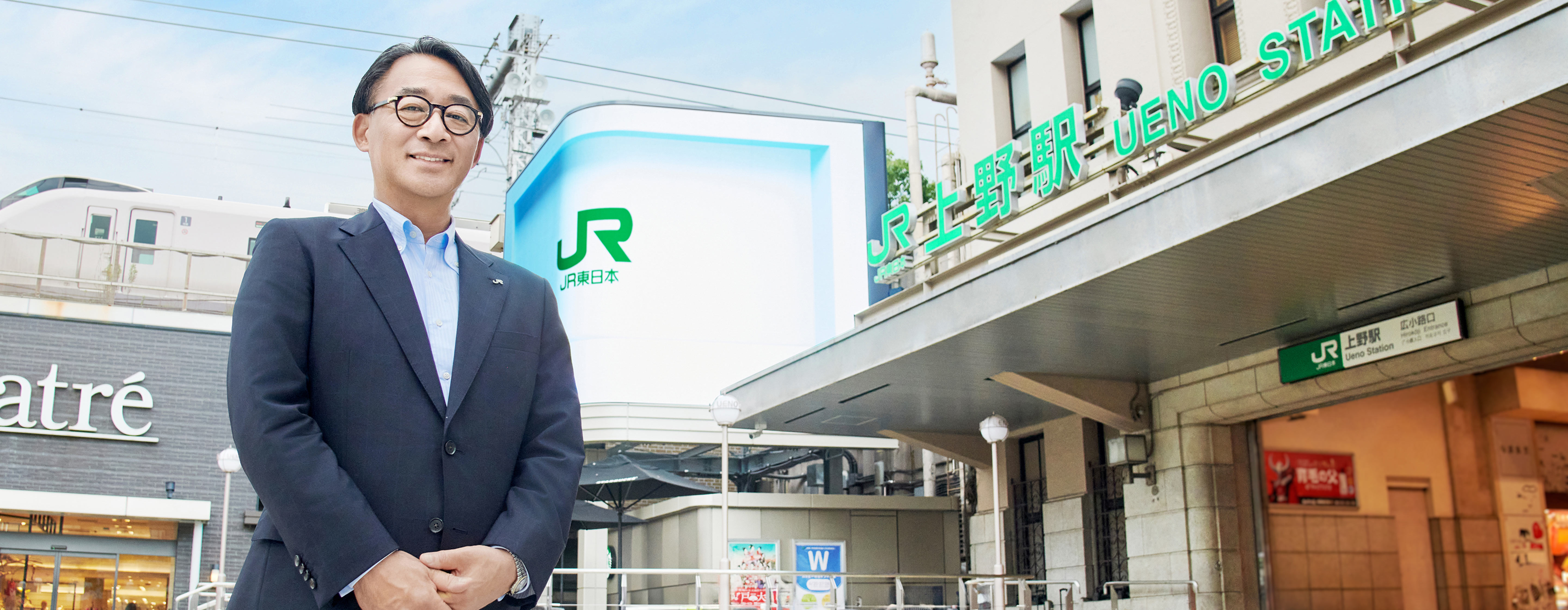
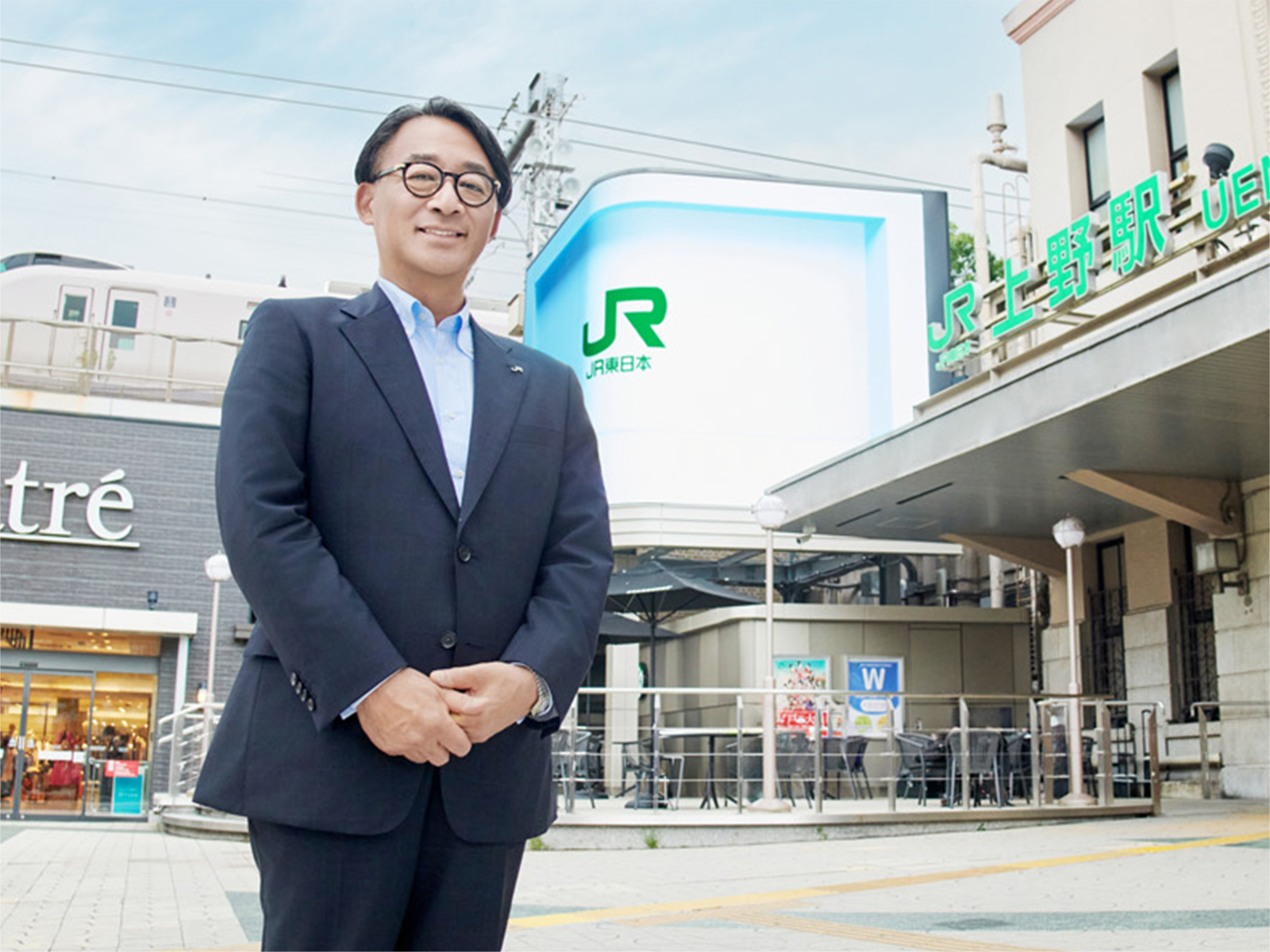
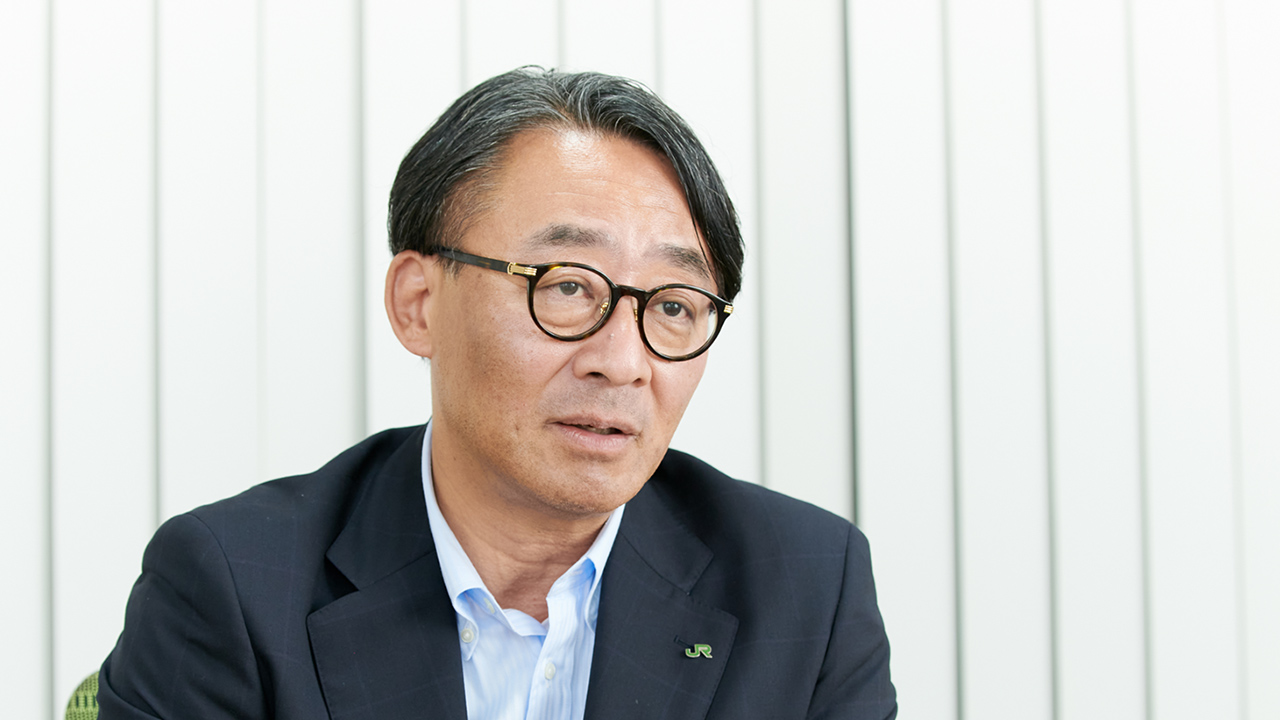
In 1989, I joined JR East as one of the first administrative career-track hires after the Company’s privatization. My first assignment after completing training was Ueno Station, the station captured in this photo. At that time, Ueno Station was a vibrant hub, bustling with passengers, and served as a key terminal for the Shinkansen, express trains bound for the Tohoku and Joshinetsu regions, as well as overnight express services. I worked as a ticket collector and ticket clerk at a JR Ticket Office here at Ueno Station. It was here that my journey as a railway professional began.
JR East was founded in 1987 through the division and privatization of the financially struggling Japanese National Railways (JNR). Despite being called the JNR reforms, the experience from a passenger’s perspective was quite different. JNR staged strikes every spring with limited regard to its users, while restrooms and other station facilities were poorly maintained, leaving general users with deeply dissatisfied. The division and privatization brought about dramatic change—literally overnight—and undergo further transformation. My motivation for joining JR East was not based on a clear vision of a bright future. Instead, I wanted to align my own career with the momentum of a founding that was driving major changes in a large organization, and I take part in the vast challenge of creating a new company.
While I recognized the importance of my assigned role as a ticket collector and ticket clerk at Ueno Station, I grew more convinced each day that the future of the railway depended on moving beyond the analog systems of that era. Although the station was bustling with users, the only concessions available at that time were KIOSKs and snack shops. Even back then, I was already thinking that transforming the way stations were used would create more diverse business opportunities. Indeed, Suica fundamentally transformed the ticket gate system, and ekinaka business model—retail spaces located inside railway stations—was launched at Ueno Station.
Since joining the Company, I have always cherished the will that I embraced at that time—to transform the present for the future— and I have consistently engaged in daily operations and management with a strong sense of responsibility—believing that it is up to us, not others, to take action. Amid a challenging business environment of increasing uncertainty, the JR East Group is accelerating structural reforms across all business areas of its operations. Personally, this represents our second founding period for the company. At this time of transformation, I feel a profound sense of connection and destiny in being forefront as president.
Progress of Move Up 2027
Each employee embracing leadership — a mindset taking root across the Group
Move Up 2027, our previous Group management vision launched
in 2018, was formulated under my leadership as General
Manager of the Management Planning Department and person
in charge of its implementation. As the name “Move Up”suggests,
this Group management vision embodied our strong
determination to carry out decisive structural transformation
across our businesses, while maintain to safety as our top
management priority. In this context, we set a medium- to long-term
timeframe of 10 years—a first for the Group.
Since the launch of Move Up 2027, the past seven years have
been marked by various transformations. The greatest
transformation I have impressed during this time has been the
remarkable shift in the awareness and behavior of our Group
employees. Each and every employee in the JR East Group has
firmly embraced the key concept, first proposed in Move Up
2027, that all employees playing a leading role in building a new
era. Through integration and collaboration across workplaces,
regions, and companies, each and every employee has taken on
various challenges to expand their fields of work and activities.
Even amid the COVID-19 pandemic, our employees never
wavered; instead, they continued to take on new challenges,
transforming the workplace and strengthening the Group. This
became the driving force behind our rapid recovery in the post-
COVID 19 era. Today, the spirit of challenge among Group
employees remains unwavering.
Safety has consistently been our highest management
priority. However, since the year before last, we have experienced
accidents and incidents that caused significant inconvenience
and concern to our customers. The past year saw cases of
misconduct and scandals that raised serious questions about
the very nature of Group governance. I am determined to carry
forward the lessons learned from deep reflection and hard-earned
experience together with the achievements of Move Up
2027, to our new Group management plan “To the Next Stage”
2034.
Our goals for the “To the Next Stage” 2034 Group management vision
Undertaking bold challenges to elevate growth while adhering
to safety as a top management priority
On July 1, 2025, the JR East Group launched a new Group
management vision, “To the Next Stage” 2034. It expresses our
strong determination to soar bravely to the next stage without
fear of failure amid a social and business environment that isundergoing significant change.
This new Group management vision carries on three points
from the earlier “Move Up” 2027. The first is our unwavering
commitment to pursue ultimate safety as the top priority of
Group management. However, in our new Group philosophy, we
have replaced “safety” with “security.” In light of the recent
serious reflections and harsh lesson, we have reconsidered
safety from the perspective of our customers who are users of our services and products, and have set higher and stricter
safety hurdles than ever before. The second is that all Group
employees play a leading role in achieving the targets of “To the
Next Stage” 2034. The third is that we aim to be a technical
services corporate group that uses innovation through
technology to enhance the level of safety and service while
transforming its operations.
Under “To the Next Stage” 2034, we will go beyond the
“norm” to build a resilient management structure supported by
the dual axes of railway-centered Mobility and Lifestyle Solutions,
empowering Group employees take on new challenges as key
players. Our areas for value creation under this new management
vision include cities, regional areas, the world, and now outer
space, and our new initiative to develop and utilize fusion energy
(nuclear fusion power generation) is just another example of
going beyond the “norm.”
In addition to strengthening both railway-centered Mobility
and Lifestyle Solutions, as symbolized by the development of
TAKANAWA GATEWAY CITY, we will leverage the unique
strengths offered by the JR East Group through these dual axes
to create new business, significantly accelerating the growth
trajectory outlined in the earlier “Move Up” 2027.
Numerical targets and cash allocation of “To the Next Stage” 2034
Drawing a growth trajectory for operating revenue of ¥5 trillion in FY2035.3
To ensure significant acceleration of growth trajectory as outlined
in “Move Up” 2027, under the new management vision “To the
Next Stage” 2034, we set a target return on equity (ROE) of 10%
or more in FY2032.3 as our KGI long-term management goal. To
that end, we aim to achieve an ROA (operating income on
assets) of 5% or more by optimizing assets and improving
profitability as the foundation for growth. We are aiming for
operating revenue of over ¥4 trillion by FY2032.3 and ¥5 trillion
by FY2035.3, the final year of the plan. Through an increase in
revenue of over ¥200.0 billion in railway-centered Mobility and
by strengthening existing businesses, accelerating the real
estate business, which is a growth engine, and promoting
strategic M&A in Lifestyle Solutions, I am fully convinced that we
can achieve our target of over ¥4 trillion by FY2032.3.
In terms of cash allocation through FY2032.3, we aim to
maximize cash inflows by expanding operating cash flow driven
by income growth in each business, as well as through asset
management, generating ¥850.0 billion from expansion of real
estate sales and ¥50.0 billion by reducing cross-shareholdings
by 30% or more. The cash obtained will be used for “Growth
capital,” “Foundation maintenance and enhancement capital,”
the new “LX capital” for groundbreaking innovations, and to
enhance shareholder returns. We raised our shareholder return
policy from a total return ratio of 40% and dividend payout ratio
of 30% from the previous Group management vision “Move Up”
2027 to a dividend payout ratio of 40%, and we implemented
flexible share buybacks. This reflects our approach to strengthen
shareholder returns while focusing cash allocation on growth
investments, particularly for Lifestyle Solutions, so we do not
miss business opportunities and to support the Group’s medium- to
long-term growth. As a result, profits will increase, leading to
an increase in the volume of cash dividends. In addition, the “LX
capital” was established to encourage employees to take on
bold challenges with a sense of enthusiasm.
Expectations for employees to realize “To the Next Stage” 2034
Elevating the challenge mindset from “Move Up” 2027 and
fundamentally revising our organization and the personnel
and wage systems as two pillars to promoting “To the Next
Stage” 2034
In May 2025, we announced our reorganization and fundamental
revision of our personnel and wage systems as two pillars to
promoting “To the Next Stage” 2034. This marks a change in the
traditional systems inherited from JNR and represents systems
befitting a new era.
We will restructure our business operations framework,
moving from a three-tiered structure—comprising frontline
workplaces, the regional headquarters / branch offices, and the
Head Office—to a two-tiered structure, eliminating regional
headquarters / branch offices. Under this new framework, 36
area operation centers handle daily operations at the customer-facing
frontline, while the Head Office focuses on Group-wide strategy development and supports the activities of the area
operation centers. The area operation centers are organized
based on usage by customers and local communities as well as
the characteristics and challenges faced by each community
and represent the basic unit of area management. By transitioning
to an area operation center framework, we will be able to
respond to community feedback and requests faster and in
more detail than ever before. By transferring authority and roles
that were previously handled by the regional headquarters and
branch offices to area operation centers, employees will have
greater opportunities to take initiative in broadening the scope of
their work, and this is expected to foster further growth and job
satisfaction.
Our personnel and wage systems will recognize the bold
challenges, growth, and achievements of each employee,
ensuring that wages will be assessed on an individual basis. In
particular, we will eliminate the demerit system and instead
proactively evaluate employees based on growth demonstrated
through their experience, regardless of failure, thereby fostering
the creation of a new organizational culture.
Currently, approximately 100,000 employees including
contract employees are engaged in daily operations in the JR
East Group. Going forward, advances in innovation will inevitably
lead to station operations being replaced by AI-powered
systems, while train crew operations transition toward driver-only
driverless operations. However, innovation will not only
drive greater efficiency and productivity but also create new
business opportunities and areas of activity within the Group.
The simple streamlining of personnel is not the mission of
management. Because, ultimately, it is people who create new
value.
The dual-axis management strategy for realizing “To the Next Stage” 2034
Evolving Suica into a device for lifestyle to build a business
foundation that generates synergy through a dual-axis
management
Our evolving Suica platform is at the foundation of Group
growth. The Suica Renaissance project announced in
December 2024 will help realize upgrades to Suica within the
next 10 years. In short, this project will transform Suica from a
mobility and small payment tool to a lifestyle platform that is
deeply integrated with customers’ daily lives.
While Suica has steadily gained popularity among customers,
with over 100 million cards issued of which over 3.5 million
downloads of the Suica Mobile app, it faces three challenges to
future growth: the need to physically touch the card to the
ticket gate, the maximum balance of ¥20,000, and the need to
preload the card before it can be used. We have plans to
overcome each of these by realizing walk-through ticket gates,
introducing a 2D barcode payment function in the Suica Mobile
app in autumn 2026, and linking the card to a customer’s bank
account or credit card. In the future, we will use cloud-based
ticketing to realize new services linking railway use with
shopping center operations, such as offering return Green Car
tickets on local trains to customers who spend a certain
amount or more at station buildings. We will also offer new
subscription products integrating railways, as well as a
Community Suica card that reflects local needs, such as and
Lifestyle Solutions as well as linking it with the Individual
Number Card system. In the housing business, this will enable
a wide range of unprecedented services, such as using ticket
gate entry and exit data to operate home appliances in
anticipation of your return home, as well as leveraging lifestyle
data to provide medical suggestions, optimal sleep schedules,
and personalized meal recommendations. In addition, the large
amounts of data stored in Suica can serve as the Group’s
unique marketing resources, enabling the creation of new
businesses in the future. Furthermore, advancements in ticket-free
technology will create profitable spaces for new business
opportunities.
Meanwhile, in our railway-centered Mobility business, the
slower-than-expected peak in the Tokyo metropolitan
population, coupled with the rapid influx of inbound travelers,
represents a major strength for the Group. For example, in
March 2025, we introduced Green Cars to the Chuo Line to
meet passenger seating needs. As a result, we expect to
generate ¥8.0 billion in annual revenues. In June, we announced
plans for direct service of the JR Musashino Line and Seibu
Ikebukuro Line with a target of FY2029.3. By identifying the
emerging needs of our railway customers and building a new
network that leverages existing infrastructure in this way, we
see significant potential for future growth. In addition, the
Haneda Airport Access Line (tentative name) connecting Tokyo
Station to Haneda Airport is scheduled to open in FY2032.3.
This will not only dramatically improve airport access, but will
also create significant benefits for hotels, commercial facilities,
and other facets of our Lifestyle Solutions business by adding
value to the Tokyo metropolitan area.
In Lifestyles Solutions, in addition to strengthening our
existing businesses through the evolution of Suica, we regard
the real estate business as one of our key drivers of growth.
Regarding the real estate fund business, we are leveraging our
strong pipeline that enables us to generate development land
from our own sites to expand the asset management scale target of our business from ¥400.0 billion targeted for FY2028.3
to ¥1 trillion for FY2032.3 under “To the Next Stage” 2034.
Furthermore, we are building the JR East Transit-Oriented
Development (J-TOD), railway network-based town
development leveraging the strengths of the JR East Group,
and we will expand this to all parts of the country. Using this
J-TOD model, we are looking into participating in town
development in Southeast Asia and South Asia in the future.
Virtuous cycle with stakeholders for the “good of all”
Exploring ways to generate profits as a corporate group with a
strong public mission
During my first address to the Group as president, I discussed
the concept of management for the “good of all”.
As a company, without profits, we would be unable to invest
in safety and service enhancements or improve the working
conditions of our employees. However, in today’s world, with the
growing emphasis on achieving SDGs through ESG-driven
management, it is becoming more important than ever for
companies to think about “how” they generate profits.
Our Group’s businesses, from railways to services closely
connected to the daily lives of our customers and local
communities, are inherently of high public interest. “Management
for the good of all” reflects our strong awareness of the public
nature of our Group’s businesses, with the aim of conducting our
business activities to create a better society. We will return the
profits garnered from these business activities to our customers,
local communities, shareholders, investors, and most
importantly, to our Group employees and their families, to ensure
their happiness. Moreover, we will also use these profits for
future growth of the Group. We will promote management that
balances these four directions. Furthermore, we will become a
highly aspirational corporate group that uses our business
activities to contribute to solving various social challenges, such
as population decline, declining birthrate and aging society,
revitalization of regional industries and employment, and energy
issues. My belief of management for the good of all has never
wavered and never will.
For our shareholders and investors, we will pursue increasing
profitability and asset optimization through management with a
strong awareness of capital costs. In addition, we aim to deliver
on medium- to long-term expectations by balancing enhanced
shareholder returns with growth investment.
Group governance
Investigating the underlying causes behind the recurring fraud, scandals, and
other inappropriate incidents to improve and
strengthen Group governance
Over the past year, a series of fraud, scandals, and misconduct
have come to light, undermining the trust that underpins JR East
Group’s business activities. Management acknowledges this as
a matter of concern and is taking steps to respond with due
diligence.
In our Railway Business , it was discovered in September
2024 that inappropriate handling—and even falsification—of
press-fit force values had occurred during the wheelset assembly
process for railway vehicles at JR East and one of its Group
companies. In our Lifestyle Solutions Business, it was
discovered that a Group company committed misconduct by
inflating personnel expenses in government-commissioned
projects. While each incident had its own specific causes and
background, we must acknowledge that this series of fraud,
scandals, and misconduct reflects underlying issues that led to
these incidents.
With the launch of “To the Next Stage” 2034, Management
faces an urgent priority to reexamine and fundamentally
restructure Group governance. To address this, in addition to
our own efforts and self-corrective actions, we established a
committee including three external experts on July 1, 2025, on
the same day To the Nex Stage 2034 was announced. The
committee was commissioned to review and provide
recommendations regarding the Group’s compliance and
governance framework. This committee will examine the
Group’s internal control systems and operational practices and
is scheduled to publish a report by the end of 2025 regarding
measures to improve and strengthen Group governance. During
FY2026.3 , the Group will formulate and implement specific
measures to improve and strengthen governance based on the
recommendations of this report. Once these specific measures
for improvement and strengthening are finalized, they will be
communicated to stakeholders.
FY2025.3 Performance Review
Creating specific results as we move on the offensive toward a new era
In FY2025.3, the Group delivered solid results, achieving
increases in both revenue and income. Operating revenue rose
for the fourth consecutive year, and all segments recorded gains
in both revenue and income. In particular, the railway passenger
revenue has reached a level close to the planned target for
FY2028.3 announced in “Move Up” 2027.
As I emphasized in my message to the Group when I became
president on April 1, 2024, in addition to pursuing management
for the “good of all,” our management approach marked a major
shift from a defensive stance taken during the pandemic to a
full-scale offensive one, as the Japanese economy entered a
new post-pandemic era.
Looking back on FY2025.3 from this perspective, it was a
year in which policies we had been examining until then were
realized in concrete terms, and new medium- to long-term
measures were made clear. Specifically, to demonstrate
organizationally that safety and service are issues for the entire
group, the Safety Management Dept., and Service Quality
Improvement Dept., which had previously been within the Railway Business Headquarters, were repositioned as
independent departments that oversee the entire Group. We
also launched Group Safety Plan 2028. In the railway business,
we began operation of Green Cars in the Chuo Line and
introduced the first driver-only operations on long-formation train
lines, including the Nambu and Joban Lines. In Lifestyle
Solutions, in addition to opening TAKANAWA GATEWAY CITY,
we established a new company to accelerate the rotational
business in the real estate business. Furthermore, as newly
outlined medium- to long-term measures, we announced the
Suica Renaissance concept as well as the launch of automated
Shinkansen operations starting with the Joetsu Shinkansen in
2029.
While FY2025.3 included accidents and incidents that
impacted railway safety and issues that required serious
reflection in Group governance, it was also a year in which we
realized key policies and made major announcements, marking
a shift in our management stance to a full-scale offensive
approach.
Management forecasts for FY2026.3
A strong start to “To the Next Stage” 2034, paving the way to a major leap forward over the next decade
In terms of our financial forecast for FY2026.3, we aim to
achieve a record-high consolidated operating revenue of ¥3.023
trillion. The railway passenger revenue is expected to exceed our
planned target for FY2028.3 announced in “Move Up” 2027.
First, in our railway business, in March 2026, we will revise rail
passenger fares for the first time since the Company was
founded, excluding the consumption tax pass-through and
barrier-free surcharges. This fare revision will not solve all the
issues related to fares, but we will continue to study ways to
make the fare and charge systems more flexible and engage in
discussions with the government. In addition, as an immediate
priority, we will aim to shift the Shinkansen express charges from
an approval system to a notification system. Furthermore, we
announced our medium- to long-term strategy for railway-centered
Mobility, “PRIDE & INTEGRITY” in September 2025.
In Lifestyle Solutions, we will promote preparations for the
grand opening of TAKANAWA GATEWAY CITY in Spring 2026. In
addition, in March 2026, we will open the OIMACHI TRACKS town development project over approximately three hectares at
the site of the former company housing. With the opening of
these two projects, we will complete the Greater Shinagawa
Area, stretching from Hamamatsucho to Oimachi and including
Shinagawa, with the aim of generating over ¥100.0 billion in
annual revenue.
In terms of technological innovations, as part of the Suica
Renaissance concept, we will conduct the first phase of
demonstration experiments of walk-through ticket gates using
facial recognition technology at Nagaoka and Niigata Stations
on the Joetsu Shinkansen for the first time. In addition, we will
promote transformation of the railway business by accelerating
the utilization of generative AI.
We will also announce a new basic plan for our services
across the Group, based on “To the Next Stage” 2034.
Finally, we will make preparations for the implementation of
the fundamental revision of our personnel and wage systems
and the reorganization in April and July 2026, respectively, as
the two pillars for promoting “To the Next Stage” 2034.
Regarding the state of Group compliance and governance,
we will receive recommendations from the committee established
to conduct reviews and provide advice, and will formulate
measures to improve and strengthen Group governance within
fiscal 2026, to be implemented across the entire Group.
In this way, in fiscal 2026, we will significantly improve
profitability and achieve record-high operating revenue of ¥3.23
trillion while creating a strong start to “To the Next Stage” 2034
and building a foundation that paves the way to a major leap
forward over the next decade.
My mission as the president
Driving a cultural shift to open a new chapter in the Group’s
history and demonstrate its true value
I joined JR East because of its appeal and potential as an
organization in its early stages and because I wanted to take
part in the various challenges involved in transforming JR East
from a national railway to a truly private company. Since joining
the Company, I have maintained a strong belief and determination
that the status quo was unsustainable, that the change was
indispensable, and that we needed take action, even through
small, but meaning efforts . Although I was only one part of a
large organizational machine, I was determined to be a gear with
sharp teeth, driving change forward. At times efforts did not
mesh smoothly, but my unwavering belief in the need for
change, my spirit of challenge, and my determination to take
action have never wavered. Together, they continue to be the
driving force that motivates me t o this day.
By April 1, 2024, most of the senior employees hired by JNR,
who had supported the JR East Group since its foundation
reached their retirement age. On the very day when the
generation hired by JR became the core of the JR East Group, I
assumed the presidency as the first from that generation. At that
time, I firmly believed that it marked a major milestone in the
Group’s history and that it was my mission to fully fulfill my role
to build a new era.
With these convictions at heart, I formulated “To the Next
Stage” 2034. For the JR East Group, whose businesses range
from railways to services closely connected to the daily lives of
our customers and local communities, the opportunities to take
on challenges to elevate growth know no national boundaries.
Achieving “To the Next Stage” 2034 will not be an easy journey,
but I am firmly convinced that without its achieving, the Group
cannot lay down a track toward its future. With this strong belief,
I am determined to lead the Group at the front.
We truly appreciate your unwavering understanding and
support going forward. As the JR East Group moves forward
along new tracks toward greater heights, we hope you will
witness each milestone with us and share in the energy as we
grow, transform, and advance into the future.
East Japan Railway Company
President and CEO
KISE Yoichi