Platform Safety Measures
| KPIs (Targets for FY2032.3) | Passenger injuries on platforms | 80% reduction compared with FY2024.3 |
|---|---|---|
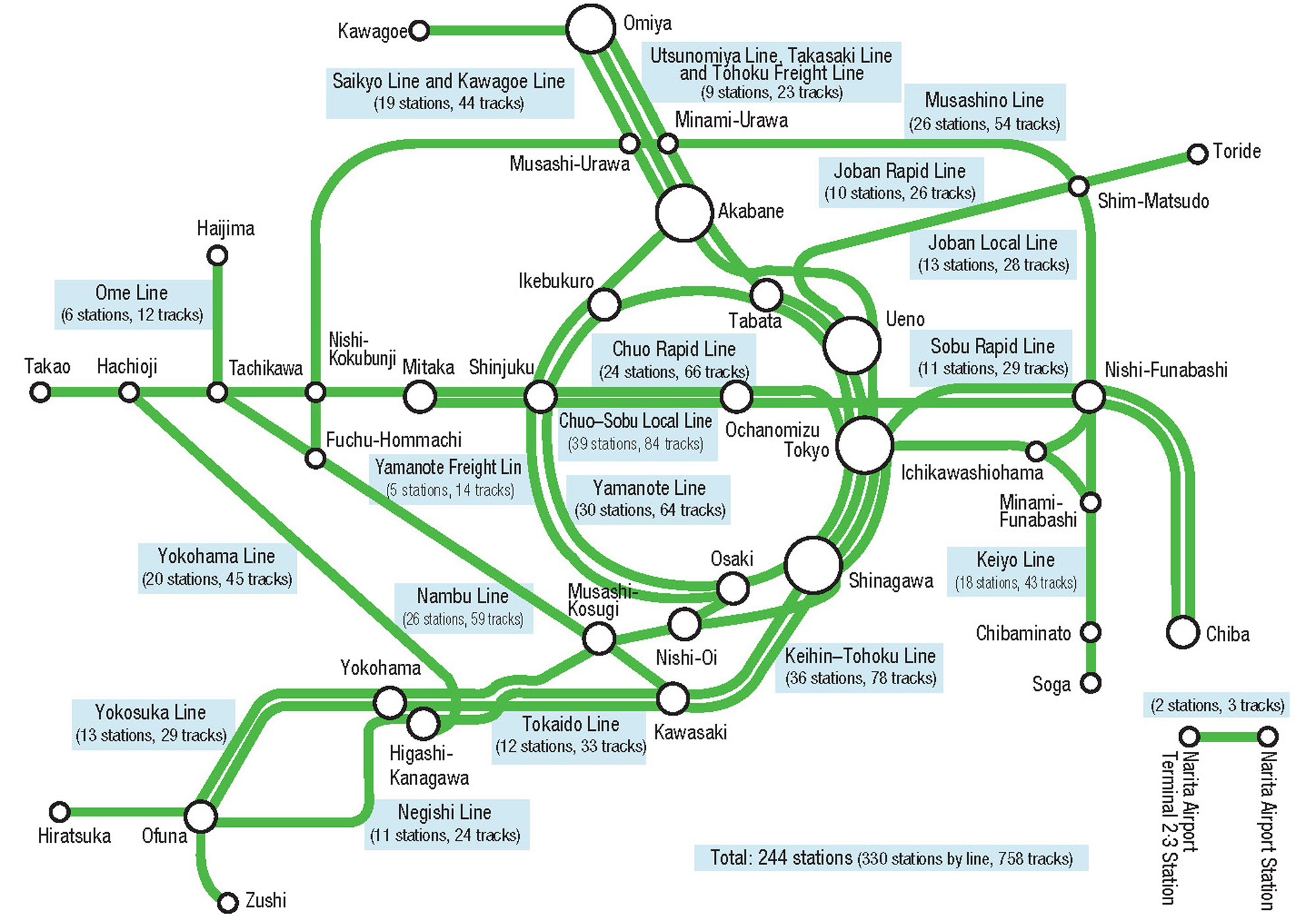
Railway stations and tracks with automatic platform gates | 330 railway stations, 758 tracks |
Tangible Perspective Measures

Platform Gate Installation
To prevent accidents involving customers falling from platforms or coming into contact with trains, we are installing platform gates. By the end of FY2026.3, we had completed the installation of platform doors at 162 stations on 345 tracks by line*, mainly on the Yamanote, Keihin-Tohoku, and Negishi lines.
Thus far, we have given priority to platform gate construction work on about 660 major tracks, with the goal of installing platform doors at 330 stations (by line) on major conventional lines in the Tokyo metropolitan area by the end of FY2033.3. To achieve even faster construction, we will expand the scope of construction to 330 stations (by line) on 758 tracks of conventional lines in the Tokyo metropolitan area, including passing sidings. We aim to complete construction by the end of FY2032.3, one year earlier than previously planned, by introducing lightweight Smart Platform Doors® and slit-frame platform doors that offer improved workability and maintainability, as well as by reducing the construction period through a review of design loads.
- *The number of stations is counted by line, e.g., Yurakucho Station is counted as two stations, one on the Yamanote Line and one on the Keihin–Tohoku Line.
Railway Lines Where Platform Gates are Scheduled for Installation by the End of FY2032.3 (Announced in April 2022)
 You can pinch out to zoom in.
Campaigns and Other Activities for Customers Using Our Railways
In addition to customer care and assistance carried out by station staff and guidance provided through station broadcasts, we
conduct the year-round Assistance and Support campaign, which receives the cooperation of not only JR East Group employees but
also general customers using our rail services to assist customers in need, including those with visual impairments.
In addition, together with various companies and agencies, we are jointly implementing campaigns such as Zero Platform
Accidents, and Stop Using Smartphones While Walking.

Expansion of Slit-Frame Platform Doors
While the JR East Group is actively promoting the
introduction of lightweight Smart Platform Doors®, we are
also continuing to install conventional platform gates in
accordance with customer usage and required platform gate
opening width. These conventional platform gates are easily
affected by wind, which makes platform improvement work
difficult, and there are issues with construction periods and
costs. Therefore, we began developing a next-generation
slit-frame platform door that maintains safety while
incorporating slits into the doors and door pockets to allow
air to pass through.
The development process was fraught with difficulties,
especially towards the end, when it was discovered that the
features of the frame structure made it vulnerable to snow
accumulation. We used the Group’s accumulated knowledge
to solve this problem and developed slit-frame platform
doors that reduce the impact of wind pressure on the
platform and platform gate support units by approximately
40% compared to conventional doors, while also simplifying
platform improvement work and improving maintainability.
The doors began operation at Bubaigawara Station on the
Nambu Line in December 2024, and full-scale deployment is
currently underway.
Platform gates are a key safety measure on platforms,
but their installation comes with various challenges. That is
precisely why it is important for everyone involved to work as
hard as they can. As a member of this team, I feel a sense
of responsibility and fulfillment, and I will continue to work
hard to realize the early installation of platform doors that will
ensure the safety and security of customers.
-

Conventional platform gates -

Slit-frame platform doors -

Smart Platform Doors®
Introducing the World’s First Platform Gates Adapted to Different Trainset Door Positions on the Tokyo Station Shinkansen Platform
We are installing platform gates to prevent passengers from falling onto tracks or coming into contact with trains. At the Shinkansen Tokyo Station (hereafter “Tokyo Station”), which is used by a particularly large number of customers, we plan to begin installing platform gates from the end of FY2029.3.
One of the challenges in installing platform gates at Tokyo Station is the need for platform gates to open according to the door positions of each arriving trainset, due to the large number of trainsets with different door positions that use the station. With a large number of trains arriving at Tokyo Station at short intervals, it is difficult for a human operator to identify each trainset and operate the platform gates accordingly every time.
To solve this problem, we will design a function—a world’s first for Shinkansen—that automatically identifies the arriving trainset and opens the platform gates according to that trainset. We are currently developing a method that uses QR codes* as a mechanism for identifying trainsets. By reading QR codes installed on the rolling stock, the system identifies the trainset and opens the platform gates automatically without requiring any intervention by human operators. This will make it possible to safely install platform gates at Tokyo Station as well. In addition, with a view to further enhancing safety and stability, we are also considering a function that will, in the future, link train doors and platform gates so that the platform gates open and close automatically in coordination with the opening and closing of the train doors.
- *QR Code is a registered trademark of DENSO WAVE INCORPORATED.
-

Image of platform gate installation on the Tokyo Station Shinkansen Platform -

Trainset identification and automatic opening of platform gates