Interview with the Head of Group Corporate Strategy


Please tell us about your current thoughts and aspirations as the head of Group Corporate Strategy.
For the past two years, I served as the director general of Tohoku Area Headquarters and the department director of Railway Operations Department, Tohoku Area Headquarters, after which I assumed the head of Group Corporate Strategy in June 2026. Prior to my assignment to Tohoku, from 2021 I served as the general manager of the Management Planning Department at the Corporate Planning Headquarters, and from 2022 to 2024 I served as the department director of Corporate Strategies Department at the Corporate Strategies Headquarters. This marks my return to a position overseeing the Group's corporate strategy after two years.I became the general manager of the Management Planning Department in the midst of the COVID-19 pandemic, where I was involved in formulating strategies to rebuild the Group following a crisis caused by an unprecedented decline in revenue over three consecutive fiscal years. The Group Management Vision at that time, “Move Up” 2027, set out the approach for growing the Group while promoting integration and collaboration and drawing out the strengths of frontline employees. This approach has been carried over to the current Group Management Vision, “To the Next Stage” 2034. The organizational restructuring implemented in July 2026 is the culmination of initiatives we have been pursuing since “Move Up” 2027. Under the previous organization, we positioned workplace of station operations, train crew operations, and maintenance as the railway frontline. The major objective of this organizational restructuring was to redefine these as frontline workplaces of the JR East Group, expanding the fields in which employees working there can thrive by handling both Mobility and Lifestyle Solutions.During my time as the general manager of the Management Planning Department, I considered how integration and collaboration should be viewed from a management perspective. A dual-axis management approach encompassing multiple business areas carries the risk of a conglomerate discount, which can erode corporate value compared to a management approach focused on achieving growth of the individual specialized companies. As such, we need to demonstrate our commitment to dispel these concerns and need to realize a conglomerate premium that enhances corporate value through the integration and collaboration of the dual axes of Mobility and Lifestyle Solutions. This is my understanding of the meaning of integration and collaboration from a management perspective.To realize this conglomerate premium, it is essential to clearly delineate responsibilities between the Board of Directors, which oversees management, and the management team, which executes business operations, and to reduce agency costs from the perspective of shareholders and investors through establishing a highly effective governance system. At the same time, clearly demonstrating the management status of business units and inter-business synergies is also an important message to shareholders and investors. We have been working to overcome these challenges one by one, believing that this will lead to the better market evaluations and understanding of our growth through conglomeration. In June 2023, we transitioned to a company with audit and supervisory committee to speed up decision-making and business execution and to enhance corporate governance. Furthermore, from April 2024, we introduced business unit management, dividing our business activities into 13 businesses and setting and managing targets, and conducting analyses for each. During my time as the general manager of the Management Planning Department, I led the execution of these two initiatives.Going forward, in order to support the bold challenges of employees in frontline workplaces and encourage proactive initiatives to improve profitability, we must implement risk management that is not only based on avoiding losses but also on the desire to create added value. Realizing a conglomerate premium while ensuring effective risk management and governance is my personal commitment as the head of Group Corporate Strategy.Following organizational restructuring, we shifted to an operating structure comprised of 36 regional headquarters, with each frontline workplace implementing a dual-axis management approach. While this sounds simple, it represents a major change for many employees who have primarily been responsible for railway operations. Visiting the workplaces, I sense a mix of excitement about tackling new challenges and apprehension about what to do and how to proceed. That’s why, as someone responsible for management, it is crucial to provide clear direction and support these challenges. “To the Next Stage” 2034 serves as a compass for this, under which we intend to move the entire Group forward by transforming both expectations and apprehension into driving forces for growth.Another objective of the organizational restructuring is to realize management through community-based business operations. By achieving full coverage of our business areas through establishing 36 regional headquarters, we can connect each regional headquarters more closely with local residents, local businesses, and local governments, expanding opportunities to local develop businesses that benefit the local community as well as ourselves. It is not necessary for all 36 regional headquarters to have the same function. We believe it is important to understand the needs of each area and take on the challenge of developing businesses that leverage the unique characteristics of each region.
Could you please explain the overall picture of the updated numerical targets in “To the Next Stage” 2034?
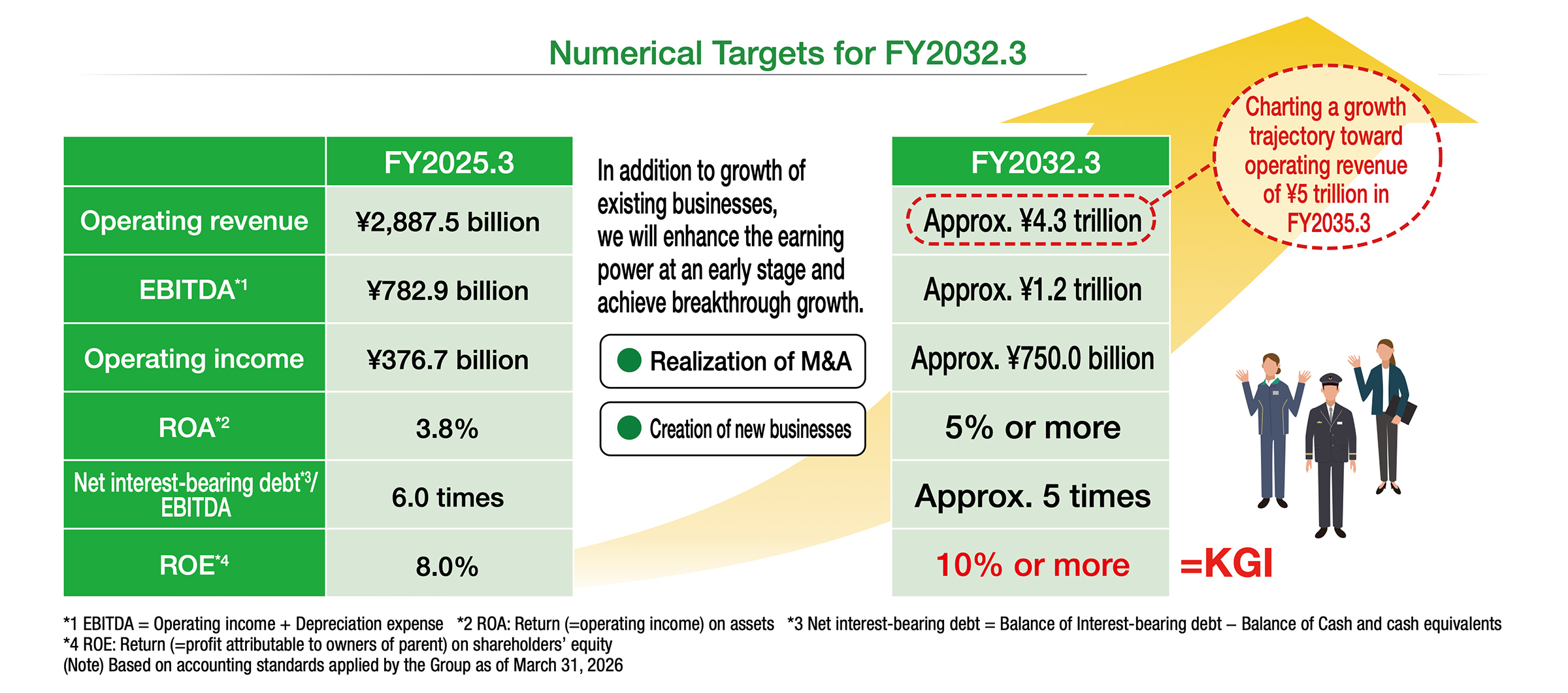
At the time of formulating “To the Next Stage” 2034, Japan’s economic growth had stagnated for nearly 30 years, while the zero-interest-rate environment persisted. However, since then, significant changes of the times have occurred, such as transition to inflation and a shift to a world with positive interest rates. Amid such an environment, company management must clearly change its mindset to deal with it. Even in launching new projects, it is necessary to shift from a conservative planning approach based on the assumption of flat revenue to setting targets that reflect inflation. I believe that today’s company management is tasked with the mission of incorporating revenue growth into their plans and setting ambitious targets that would have been unthinkable under a traditional, conservative mindset.The reason why we raised the numerical targets in “To the Next Stage” 2034 is to respond to these changes in the business environment. Additionally, the fact that railway usage in Mobility has exceeded expectations and is currently performing very well is also a major contributing factor. Railway transportation revenue has recovered to almost pre-COVID-19 levels, and inbound demand is also growing strongly. Furthermore, in Lifestyle Solutions, we have revised the growth rates of each business to account for inflation.Based on the above, in this update we raised the numerical targets for FY2032.3 initially set in “To the Next Stage” 2034, and also adjusted the numerical targets for FY2028.3, which serve as a stepping stone. We raised our operating revenue target for FY2032.3 from previous “over ¥4 trillion” to “approximately ¥4.3 trillion,” and our operating income target from “approximately ¥700.0 billion” to “approximately ¥750.0 billion.”Of which, we raised our FY2032.3 operating revenue target for Mobility by ¥100.0 billion from “over ¥200.0 billion plus the FY2025.3 result (¥1,945.7 billion),” to “over ¥300.0 billion plus the FY2025.3 result.” We also raised our operating income target from “approximately ¥250.0 billion” to “approximately ¥260.0 billion.”For Lifestyle Solutions, we had previously aimed to double operating revenue (¥847.0 billion) and operating income (¥170.3 billion) compared to FY2024.3 results, but have moved these targets forward by two years to aim for achievement in FY2032.3. On top of this, we are also targeting increases of ¥150.0 billion for operating revenue and ¥100.0 billion for operating income.In our most recent FY2026.3 earnings, Mobility accounted for 66.3% of total operating revenue, while Lifestyle Solutions accounted for 33.7%. As we make headway with our dual-axis management approach, we expect the proportion for Lifestyle Solutions to increase, approaching a 50:50 ratio. Going forward, the real estate business in particular will play a strategically important role in accelerating the expansion of Lifestyle Solutions. I will discuss the real estate business in more detail when explaining our initiatives to maximize corporate value later.
What strategies will you pursue going forward to maximize corporate value?

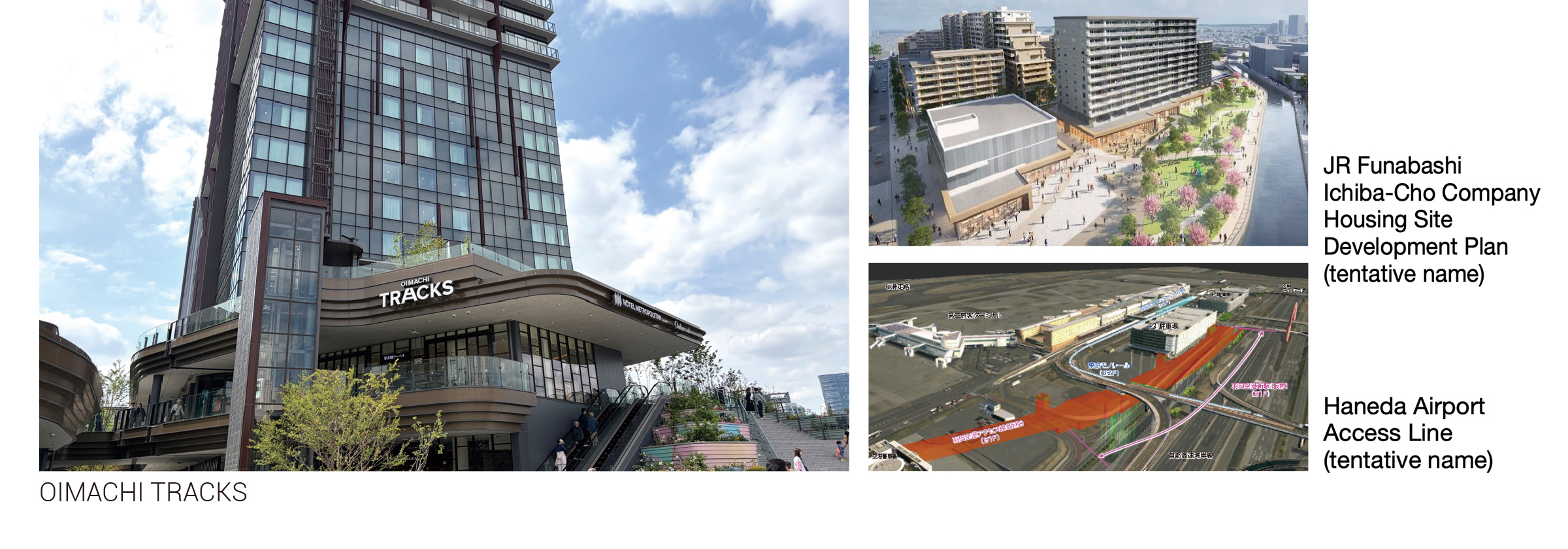
In maximizing the corporate value that the JR East Group aims to achieve, our key focus is creating the conglomerate premium I mentioned earlier, while placing the greatest value we have built—safety and security, and the customer trust generated by them—at the core of both our Mobility and Lifestyle Solutions. We need to promote integration and collaboration through our dual-axis management approach, foster positive synergies across multiple businesses, and drive the creation of a conglomerate premium. We have set this as our basic policy for maximizing corporate value. As part of these initiatives, we will foster a mindset shift among employees working in frontline workplaces and take on the challenge of expanding our business fields. At the same time, it is important to pursue a strategy that maximizes the use of our existing assets from an overall management perspective.Specifically, we will review how we utilize the assets of the railway business and, as a unique JR East Group approach for effective utilization, enhance the value of our real estate by improving railways while simultaneously developing the areas around stations in an integrated manner. We have positioned this strategy as the railway network-based urban development (JR East Transit-Oriented Development, J-TOD), through which we aim to maximize consolidated cash flow. A prime example of this is TAKANAWA GATEWAY CITY, which had its grand opening in March 2026. We relocated a large rolling stock center from the city center to the suburbs to free up land, which we then proceeded to develop with the aim of generating revenue and expanding real estate value. While not many are of this large scale, the Group possesses a variety of assets if we include those on the smaller side, including rolling stock centers and former company housing sites. We intend to steadily implement effective utilization of these assets and expand the synergies between Mobility and Lifestyle Solutions.Regarding specific initiatives, for the Mobility business, we will expand capital investment based on the increased revenue from the fare revision implemented in March 2026, and improve safety and service levels to build the railway of choice for more customers than ever before. The fare revision is something we have been negotiating with the government about since my time as the general manager of the Management Planning Department. Under the previous total cost method for setting fares, past unmade capital investment could not be reflected in depreciation. Consequently, the cash required for new capital investment, such as installing automatic platform gates, had to be secured through revenue or loans, for example. In order to steadily make investments geared toward the future, we needed to review the systems. Following discussions with the government, we were able to establish a mechanism that allows depreciation expenses associated with future capital investment to be reflected in advance. These changes were reflected in the 2024 revision of the government’s guidelines for calculating revenue and costs, leading to the realization of the fare revision. Going forward, we anticipate this resulting in an increase in annual revenue of approximately ¥82.0 billion. Of course, in addition to fare revisions, we will aim to strengthen profitability by expanding customers' daily use and proactively working to attract inbound tourists. To expand daily use, we will roll out Green Cars on the Chuo Rapid Line and Ome Line, proceed with preparations for direct through-services between the Musashino Line and Seibu Ikebukuro Line, and for opening the Haneda Airport Access Line (tentative name). Furthermore, we will implement projects such as multidimensional tourism and living in two regions based on our agreement to strengthen cooperation for regional revitalization in the East Japan area concluded with Japan Airlines Co., Ltd. With regards to attracting inbound tourists, we intend to highlight and actively promote the appeal of the Tohoku region, which has significant growth potential. As for the Mobility business, to improve profitability from both perspectives of top-line expansion and cost controls through these initiatives, we will implement productivity improvement measures such as mechanization and the use of DX and AI. A concrete example of this is driver-only railway operations, which has already started on the Nambu and Yokohama Lines, among others. While ensuring safety by utilizing automatic platform gates and sensors, going forward, we plan to gradually expand this to lines with high passenger volumes, such as the Yamanote Line and Keihin-Tohoku Line. In addition, we plan to streamline and improve the efficiency of maintenance operations by installing cameras and sensors on trains to monitor the condition of equipment during operation and using AI-based data analysis systems. By reducing costs in this way, we aim to increase the operating income margin for the Mobility business from the current 9.5% to 11.5% by FY2032.3.For the Lifestyle Solutions business, as mentioned earlier, the real estate business will serve as a key growth driver. We have positioned the area between Hamamatsucho and Oimachi, including TAKANAWA GATEWAY CITY and OIMACHI TRACKS, as the Greater Shinagawa Area as a future pillar of growth, and will pursue an area strategy with a view to achieving annual operating revenue of over ¥100.0 billion by the mid-2030s. As for new initiatives, based on our strategic alliance with the ITOCHU Group in the real estate business field, we will promote a for-sale homes business that combines our respective strengths. We will establish JREAST & ITOCHU REAL ESTATE DEVELOPMENT Co., Ltd., the main entity for this business, in October 2026, and aim to achieve operating revenue of ¥250.0 billion and operating income of ¥35.0 billion in FY2031.3. We also plan to expand the scale of the assets under management in our real estate fund business, launched in FY2022.3, to ¥1.2 trillion by FY2032.3.Another major growth driver is Suica. Thus far, Suica has grown as a device for mobility to ride trains. Going forward, we will evolve it into a lifestyle device. We will strengthen the collaboration between Mobile Suica and the JRE POINT program, aiming to create a platform that can be used not only for railway use, but also for all aspects of daily life such as shopping, dining, and local services. The Community Suica services under consideration in Miyagi and Gunma Prefectures represent a new initiative aimed at achieving integration with local government services. We want to cultivate Suica as a core infrastructure that connects Mobility with Lifestyle Solutions.To maximize corporate value, we must optimize resource allocation based on our business portfolio and maintain a stance toward surely capturing growth. We will accurately monitor the operation of our 13 business units and promote portfolio strategies aimed at expanding consolidated cash flow, including withdrawing from areas where expected profitability or synergies fail to materialize.
Please explain your cash allocation strategy up to FY2032.3
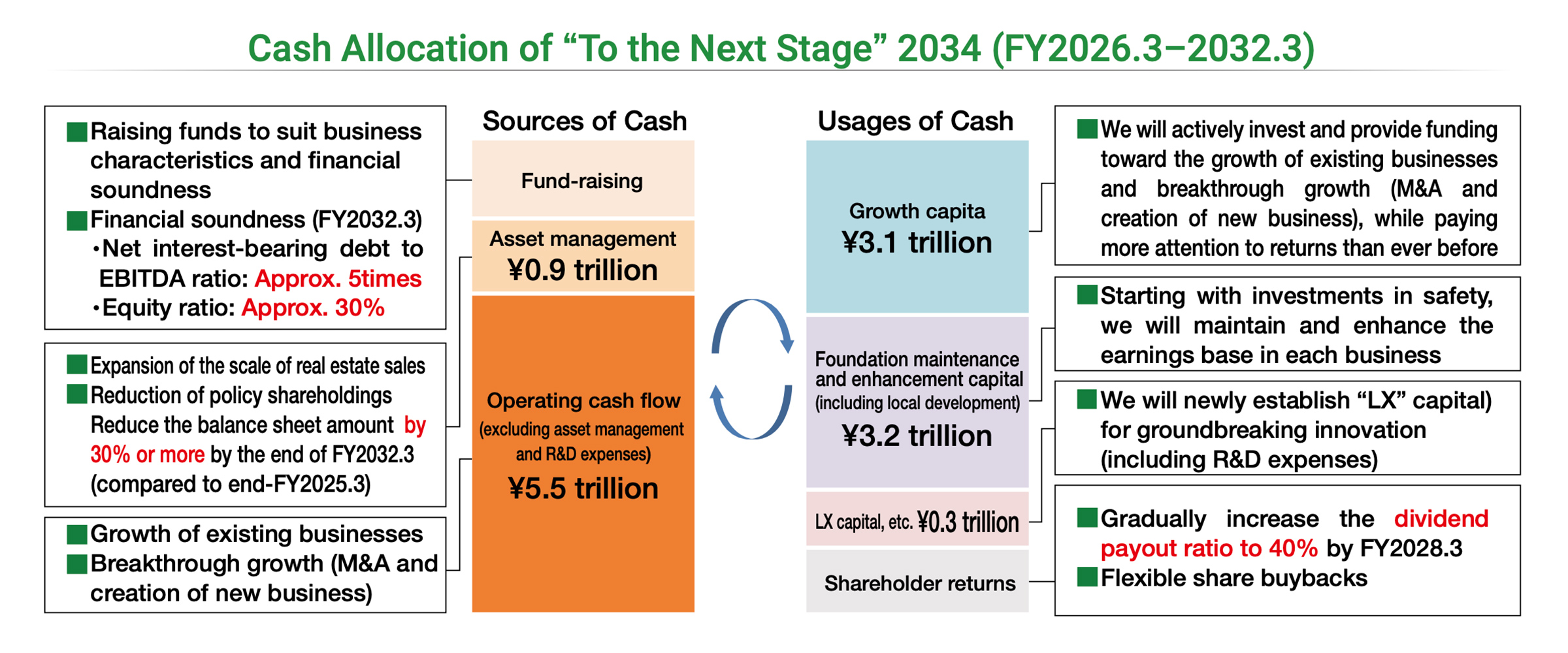
Regarding sources of cash, we expect to secure a cumulative operating cash flow of approximately ¥5.5 trillion through our business activities over the seven years spanning FY2026.3 to FY2032.3. In addition, we anticipate securing approximately ¥850.0 billion from the sale of our real estate holdings and approximately ¥50.0 billion from reduction of our cross-shareholdings by 30% or more, for a total of approximately ¥6.4 trillion in internal cash inflows. Regarding usages of cash, we plan to allocate approximately ¥3.1 trillion over the seven-year period as growth investment, primarily in our real estate business, including M&A and new business creation. Growth investments, if not timed correctly, can delay commercialization, undermine competitive positioning, and ultimately defer cash generation. As such, we will accurately capture business opportunities and execute them in a timely manner. Lifestyle Solutions will account for the bulk of this allocation, receiving approximately ¥2.6 trillion of the roughly ¥3.1 trillion total investment. The remaining ¥500.0 billion or so will be allocated to the Mobility business. Of this amount, as a significant investment, approximately ¥210.0 billion will be invested in the Haneda Airport Access Line (tentative name).Meanwhile, the Group’s assets, centered on our railway operations, also require funding to maintain and strengthen the foundation for sound operations, including ensuring safety and convenience as transportation infrastructure. We plan to invest roughly ¥3.2 trillion in this area over the seven-year period.Another designated use of cash is Lifestyle Transformation (LX) capital, set aside to drive groundbreaking innovation. As an example, the hydrogen hybrid trains HYBARI, which has been undergoing trial runs on the Tsurumi Line and Nambu Line, will be modified for commercial use and is scheduled to begin commercial operation by the end of FY2028.3. We have earmarked up to ¥300.0 billion to fund investments in these new fields and technological innovation.In total, these usages will result in cash outflows of approximately ¥6.6 trillion over the seven-year period. If we include the funds needed for shareholder returns, our internal cash inflow of approximately ¥6.4 trillion will fall short of total cash needs. To bridge this gap, we will secure required cash through fundraising such as bank loans and bond issuances. Maintaining financial soundness is essential to executing fundraising as needed while making large-scale growth investments and foundation maintenance and enhancement. We will control the balance between our earning power and interest-bearing debt according to the respective characteristics of our Mobility and Lifestyle Solutions, and maintain a net interest-bearing debt to EBITDA ratio of approximately 5 times as part of our financial discipline. We also aim to maintain an equity ratio of approximately 30%.
What message would you like to convey to our shareholders and investors?
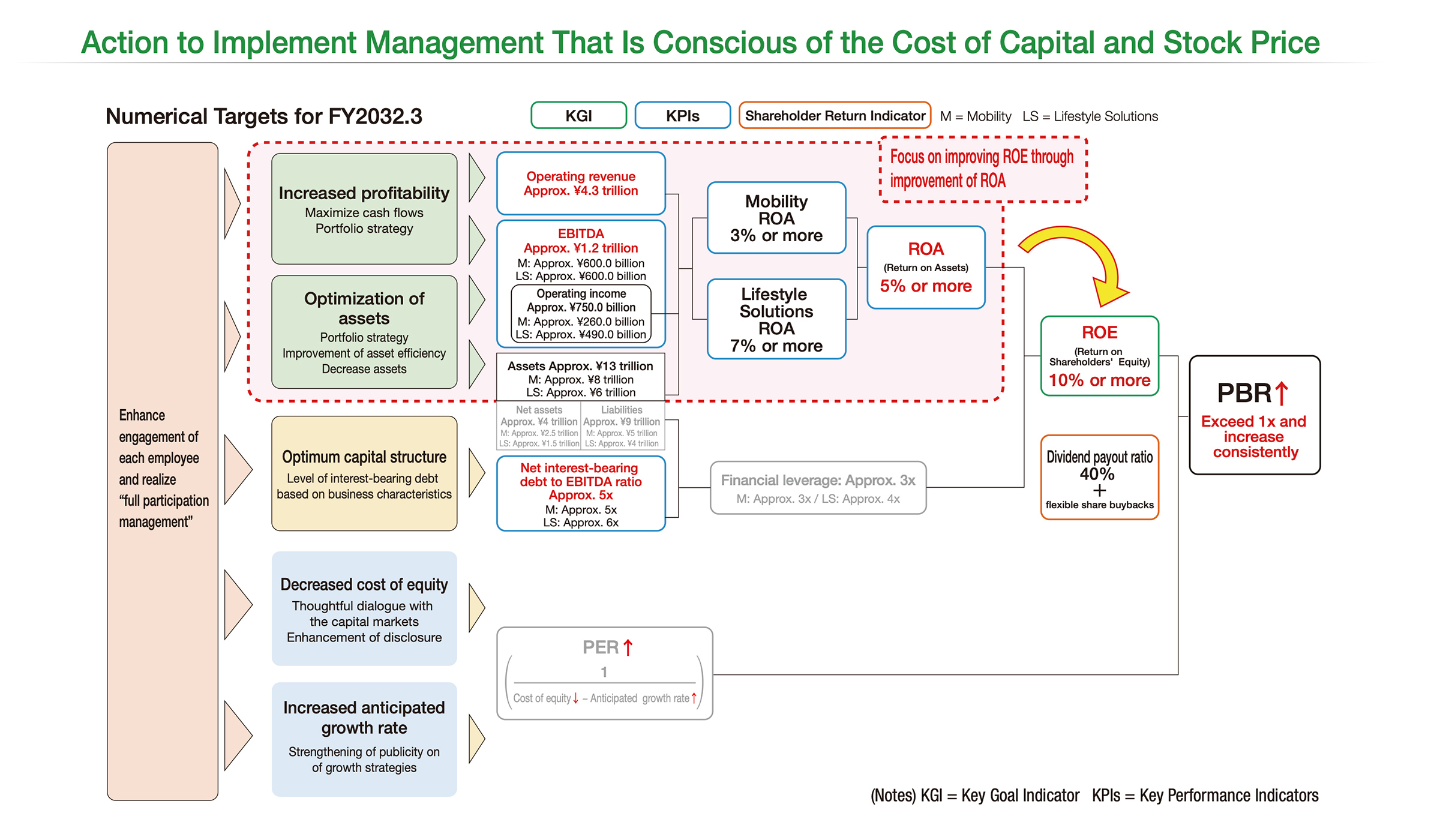
Over the past few years, in corporate management, there has been increasing emphasis on action to implement management that is conscious of the cost of capital and stock price. Accordingly, we analyze and evaluate the current status of our management twice a year and updates our action plan for improvement. Currently, we recognize our cost of equity as being around 6–7%. We aim to achieve our KGI (Key Goal Indicator) of ROE of 10% or more by FY2032.3, and we will reduce our cost of equity and expand the equity spread by increasing opportunities for dialogue with our shareholders and investors. During my time as general manager of the Management Planning Department, I was particularly conscious of two-way communication with shareholders and investors. I have strived to achieve better communication by understanding the needs of shareholders and investors through various touchpoints and reflecting them in subsequent opportunities. While we recognize that our information disclosure practices have been positively evaluated to a certain extent compared to two years ago, we acknowledge that there is still substantial room for improvement. We aim to further improve our practices by continuing to receive candid feedback.While an increasing number of companies are using ROIC as a monitoring indicator for management, in our case, since the ROIC figure is very close to ROA (return on assets), we have adopted ROA as our indicator because it is easier to understand. Given the asset-heavy nature of our business model, we will increase profitability and asset efficiency to reach our FY2032.3 ROA target of 5% or more (3% or more for Mobility, 7% or more for Lifestyle Solutions) with an eye to achieving our KGI of ROE of 10% or more.Furthermore, PBR, which indicates the stock market’s valuation, has risen to pre-COVID-19 levels, driven by increased growth expectations, since the announcement of “To the Next Stage” 2034, driven by increased growth expectations, and currently stands at around 1.3 times. Moving forward, we will continue to drive PBR expansion through a dual focus on improving profitability and communicating our growth expectations.Regarding shareholder returns, we plan to gradually increase the dividend payout ratio to 40% in FY2028.3, steadily increasing dividends through continuous profit growth. Based on this policy, we paid an annual dividend of ¥74 per share for FY2026.3 (interim dividend of ¥35 and year-end dividend of ¥39), equating to a dividend payout ratio of 33.7%. For FY2027.3, assuming profit growth, we plan to pay an annual dividend of ¥84 per share (interim dividend of ¥42 and year-end dividend of ¥42), equating to a dividend payout ratio of 37.2%.We ask for your continued expectations for the JR East Group’s efforts to soar and continue evolving through dual-axis management, as well as your long-term support.