Press Releases(Archive)
Development of the World's First Fuel Cell Hybrid Railcar
East Japan Railway Company
April 11, 2006
East Japan Railway Company has researched and developed a fuel cell system for railcars as an independent type motive power system that reduces the burden on the global environment and can also overcome the problem of exhaustion of fossil fuels. Based on these results, the company is proceeding with development of the world's first fuel cell hybrid railcar.
This fuel cell hybrid railcar will be realized by modifying the New Energy train (NE train) used for development of a diesel engine-based hybrid system. Testing is scheduled to start from July 2006, and various tests will be performed to confirm the fuel cell performance, environmental burden reduction effects, hydrogen supply system and other aspects. Development of railcar system technology that uses fuel cells is also being promoted to utilize future breakthroughs in fuel cell technology.
- Aim of fuel cell system development
Fuel cells that use hydrogen as fuel make it possible to:
- Further reduce the burden on the environment.
- Provide new motive power systems that overcome the problem of exhaustion of fossil fuels.
In addition, the generation of power using fuel cells mounted on each railcar can also be expected to reduce the scale of wayside facilities and improve railway appearance.
- Goals of this development
In order to realize a fuel cell system capable of providing the above effects, the development for this fiscal year aims to:
- Develop railcar system technology using fuel cells that can utilize future breakthroughs in fuel cell technology.
- Understand issues when using fuel cell systems with railways.
For this purpose, JR East is promoting development of the following test railcar.
- Development outline
(1) Test railcar configuration
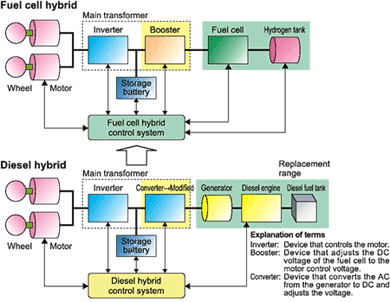
The engine and generator of the current NE train will be replaced with fuel cells. The control system will be a hybrid system that uses a combination of the fuel cells and the energy from storage batteries to drive the motors.(2) Fuel cell specifications
The test railcar will be equipped with solid polymer type fuel cells that use hydrogen as fuel.
Fuel cells with high power output and high reliability that can support a railcar system have been selected, and two 65 kW output fuel cells will be mounted on the test railcar.(3) Railcar outline, main features and schedule
1. Fuel cell hybrid railcar
This development is a modification of the NE train. From the beginning of its development, the NE train has been designed for modification to a fuel cell railcar. Now that prospects have been reached for practical application of a diesel hybrid system, development of a fuel cell railcar is the next step. The figure below shows an image of the railcar.

2. Fuel cell hybrid railca
The test railcar uses the NE train car body and running equipment as is, and aims for performance equivalent to the current NE train.

NE trainMain features of the test railcar
* Values when using a hydrogen tank of the type that can currently be used with railcars.Railcar Single-car configuration Railcar dimensions (L x W x H) 20,000 x 2,800 x 4,052 mm Maximum speed 100 km/h Main motor type and output Induction motor, 95 kW x 2 units Fuel cell type and output Solid polymer type, 65 kW x 2 units Storage battery type and capacity Lithium-ion type, 19 kWh Hydrogen tank capacity and pressure Approximately 270 liters, 35 MPa (*) Schedule
• From July 2006: In-yard checking of basic performance Checking of safety • From April 2007: Planned running tests on an actual service line 3. Image of a future railway that uses a fuel cell system
The future introduction of fuel cell railcars will make it possible to eliminate catenary facilities, allowing effective use of the space above tracks. In addition, it will also improve the railway's appearance. 
4. Control system for fuel cell hybrid railcar
The control system for the fuel cell railcar is based on the diesel hybrid system, but replaces the diesel generator with a fuel cell. This efficient system supplies the necessary electric power from both the fuel cell and the storage battery when accelerating, and saves the electric power produced by the regenerative brakes in the storage battery when braking.
5. Fuel cell system
Hydrogen is separated into hydrogen ions (H+) and electrons at the cathode, and then oxygen, hydrogen ions and electrons react at the anode to produce water. At this time the electrons move from the cathode to the anode, producing electricity. 
